Wednesday, 18 December 2013

Gaudete Sunday 2013 : 3

Twice a year, the Church breaks the tone of its penitential seasons by the use of rose-coloured vestments.  Rose-coloured vestments were never commonplace and they still are not.  Many different colours have been deemed by the Church as acceptable as liturgical rose.  Some of these are a salmon shade; some a silvery-pink, almost mushroom-colour; some close to what we would call Bishop's purple or fuchsia; and some red with overtones of gold.

For Gaudete Sunday 2013, we feature four completely distinct rose vestments made by the Studio; the first and second were shewn in the previous posts.

The third set of vestments, (see adjacent images) - in the Saint Philip Neri style - is made from a quite different shade of rose. It is a colour between crimson and purple and made from dupion silk. To accentuate the colour of the vestment, the lining is made from a much lighter and "salmon" rose (see image below). The orphrey of this chasuble is formed from one of the Studio's newly-designed Puginesque braids in colours of burgundy, red and ash-grey.

Click on the image for an enlarged view.

Enquiriesstbede62@gmail.com


Saturday, 14 December 2013

Gaudete Sunday 2013 : 2

Twice a year, the Church breaks the tone of its penitential seasons by the use of rose-coloured vestments.  Rose-coloured vestments were never commonplace and they still are not.  Many different colours have been deemed by the Church as acceptable as liturgical rose.  Some of these are a salmon shade; some a silvery-pink, almost mushroom-colour; some close to what we would call Bishop's purple or fuchsia; and some red with overtones of gold.

For Gaudete Sunday, we feature four completely distinct rose vestments made by the Studio; the first was shewn in our previous post. The second set of vestments, (see adjacent image) - in a free interpretation of the Gothic style - is made from a rich shade of dupion silk. The orphrey of this chasuble is formed from a newly-designed braid of knotwork in shades of ash-grey, black and orange.

Click on the image for an enlarged view.

Enquiriesstbede62@gmail.com

Thursday, 12 December 2013

Gaudete Sunday 2013 : 1

Twice a year, the Church breaks the tone of its penitential seasons by the use of rose-coloured vestments.  Rose-coloured vestments were never commonplace and they still are not.  Nevertheless, you will find various pronouncements these days (usually on websites) about what the real or authentic shade of rose is which is to be used for vestments.

Newsflash: there is no official shade of Rose designated by the Church, nor has there ever been.  The reason for this is rather simple: only in the last century did the process of dyeing fabric become sufficiently sophisticated to ensure that much the same shade of a colour emerged from one batch of fabric dyeing to another.  Previous to that, dyes were derived from plants etc., made up with a great deal of labour.

Many different colours have been deemed by the Church as acceptable as liturgical rose.  Some of these are a salmon shade; some a silvery-pink, almost mushroom-colour; some close to what we would call Bishop's purple or fuchsia; and some red with overtones of gold.

Another thing is certain: Bubblegum Pink is not Rose, nor has it been a traditional variation for use on these days.   Whilst not intending to get into the argument as to whether the use of a such a vibrant pink is a fitting colour for a man to wear,  "Bubblegum Pink" certainly manifests a lamentable lack of liturgical good taste.  Sadly, pink-coloured vestments, purporting to be Rose, are becoming increasingly commonplace and now even appear at Papal Masses.

At an old post on the Blog, The New Liturgical Movement, we find a number of interesting vestments in that shade of rose commonly found in Italy in centuries past: a reddish colour with overtones of silver.  Go there and take a look.  The same article also shews the considerable variety of older rose-coloured vestments, in use throughout Europe.  Often, embroidered flowers on such vestments was a device used to enhance the "rosiness" of the vestment.

As Gaudete Sunday approaches, we feature here four completely distinct rose vestments. Firstly, this vestment (see above image), made in the Borromeon style from a beautiful English silk damask. The orphrey of this chasuble is formed from a Puginesque braid in shades of burgundy, red and ash-grey.

Click on the image for an enlarged view.

Enquiries: stbede62@gmail.com

Saturday, 7 December 2013

On the Feast of Saint Ambrose

To commemorate the Feast of Saint Ambrose, bishop of Milan and a Doctor of the Church, we are pleased to present these works of art depicting the great saint.

The painting included below, by the Italian artist Camillo Procaccini, was painted in Milan towards the end of the sixteenth century, or early in the seventeenth, and depicts Saint Ambrose staying the Emperor Theodosius. In this painting we the see the saint vested in pontificals of this period. Fittingly, Saint Ambrose is shewn vested in a chasuble of the Borromeon proportions (fitting since Saint Charles Borromeo was also Bishop of Milan).  Note that the chasuble is wide, being slightly turned back at the elbows. It is ornamented with a prominent TAU of gold damask. Saint Ambrose is also shewn wearing the tunicle and dalmatic over his albe. By this time, the pallium had more or less reached the form that we are now familiar with.

Saint Ambrose by Procaccini.
Further below is included a painting of Saint Ambrose from a later period by the Italian artist Carlo Ceresa who lived and died in the seventeenth century. Ceresa's painting of the saint shews certain changes to the form of the chasuble which occurred during the seventeenth century. In this painting, the saint is depicted wearing a less ample chasuble, sometimes referred to as the style of Saint Philip Neri. The chasuble is not as long or as wide as the first painting shewn, and it is also less flowing. Note the close-fitting sleeves of the albe shewn in Ceresa's painting.

A curiosity of this painting is that in its upper left background, Saint Ambrose is shewn wearing the same Pontificals (including the mitre!) in full gallop on a horse.  The chasuble flares at the back.


Saint Ambrose by Ceresa.

UPDATE:
A friend of the Studio and reader of this Blog, offered the following comments on Saint Ambrose astride the horse:

Saint Ambrose has traditionally been pictured with a scourge because of his routing of heretics, particularly of the Arian persuasion - and the cherub in the righthand bottom corner of Ceresa's painting is holding such a scourge. But on looking closer at Saint Ambrose on horseback in the background this also shows him with a much longer scourge in his right hand, while all around the horse's feet lie broken bodies etc - again, I assume a reference to him being a scourge of heretics. He was known to be both a gentle Bishop, but also a vigorous denouncer of heretics, and I imagine the picture within the picture picks up on this. 

Click on the images for an enlarged view.


Saturday, 30 November 2013

The Colours of Advent

Often it is asserted by liturgical commentators and other internet experts, that there are "correct" colours for the vestments used during Lent and Advent. Curious as to the history of these colours in Liturgical use, some years ago we researched and posted an article  here and here, about use of penitential colours for the Seasons of Advent and Lent. If you have wondered what colour the Church recommends for these Seasons, you might find the article illuminating.  

We include here an historic work of art to illustrate the practice of our forebears. This work (adjacent) was painted by an artist known as The Master of Osservanza in the year 1440 and depicts a Low Mass being offered at a side chapel in the Siena Cathedral (Italy).

Some observations. The chasuble being worn by the celebrant is violet: in other words, much the same colour as the flower "violets". It is a blue-ish colour, not purple and it is not too dark either. The chasuble is the full conical shape and is ornamented with a simple column-orphrey of dark fabric (possibly even black). Most likely, the front of the chasuble would have been decorated with the familiar "tau". The celebrant is wearing decorative apparels on his alb and amice, which match the colour of the chasuble's ornament. That is a very typical practice of the Mediaeval period. Note, too, the very full folds of the alb.

We see, also, that the boy assisting the celebrant is wearing a full-length surplice, according to the style typically found in Renaissance Italy. Those who claim that such surplices are "Church of England" garment should note this well.

Lastly, the altar itself. It is clothed in a dark antependium or altar frontal, ornamented with scarlet red. On the altar is a Crucifix and a single candle. Although it may seem peculiar that there is but a single candle instead of a pair, it might be remarked that not until the 16th century was it a usual practice to have a pair of candlesticks on an altar.

Click on the image for an enlarged view.

Tuesday, 26 November 2013

Concluding the Time "Per Annum"

At the conclusion of the 2013 Liturgical Year, we are pleased to present this pleasing set of green vestments.

A priest of the Archdiocese of Dublin, a returning customer, commissioned the Studio to make a set of vestments in a subdued shade of green. After a great deal of searching, a dupion silk in a rich shade of olive green was chosen for the vestments.

The chasuble, in the Saint Philip Neri style, is ornamented with a rich brocade of burgundy and gold according to the Roman form. The vestments are lined with a wine red taffeta.

Enquiries: stbede62@gmail.com

Click on the images for an enlarged view.


Wednesday, 13 November 2013

Beuron School of Liturgical Art

Above is a beautiful liturgical drawing from 1910  in the Beuronese style  Messe mit Wandlungskerze auf dem Altar. It was found at the Wikimedia Commons. Go here to read a little about the Beuron School of liturgical art.

This stylised depiction of a priest celebrating Low Mass is rich with the aesthetic ideals of the Liturgical Movement. The celebrant wears a flowing albe, ornamented with continuous decoration around its hem. Over this he is vested in a conical chasuble, decorated very simply. Not least of interest is the manner in which the altar cloth is decorated, with geometric embroideries and tassles of silk. 

One curiosity is the almost sleeveless surplice being worn by the altar server. Note the restrained gesture with which he lifts the celebrant's chasuble for the Elevation.

Would that this dignified aesthetic were more fully adopted for the celebration of Mass according to both usages of the Roman Rite.

Saturday, 9 November 2013

South Korea : 2


The Saint Bede Studio has completed a commission for two sets of vestments for a Latin Mass Community in South Korea. This is the Studio's first work in Asia. The first set was featured in a recent post; the second set is shewn in the adjacent photographs.

This is a Low Mass set in the Borromeon style of the 16th century. The vestments were made from an ecclesiastical brocade in muted gold and ornamented with an Italian damask in colours of wine red and gold. A floral galloon outlines the ornament.

Enquiries: stbede62@gmail.com

Click on the images for an enlarged view.


Wednesday, 6 November 2013

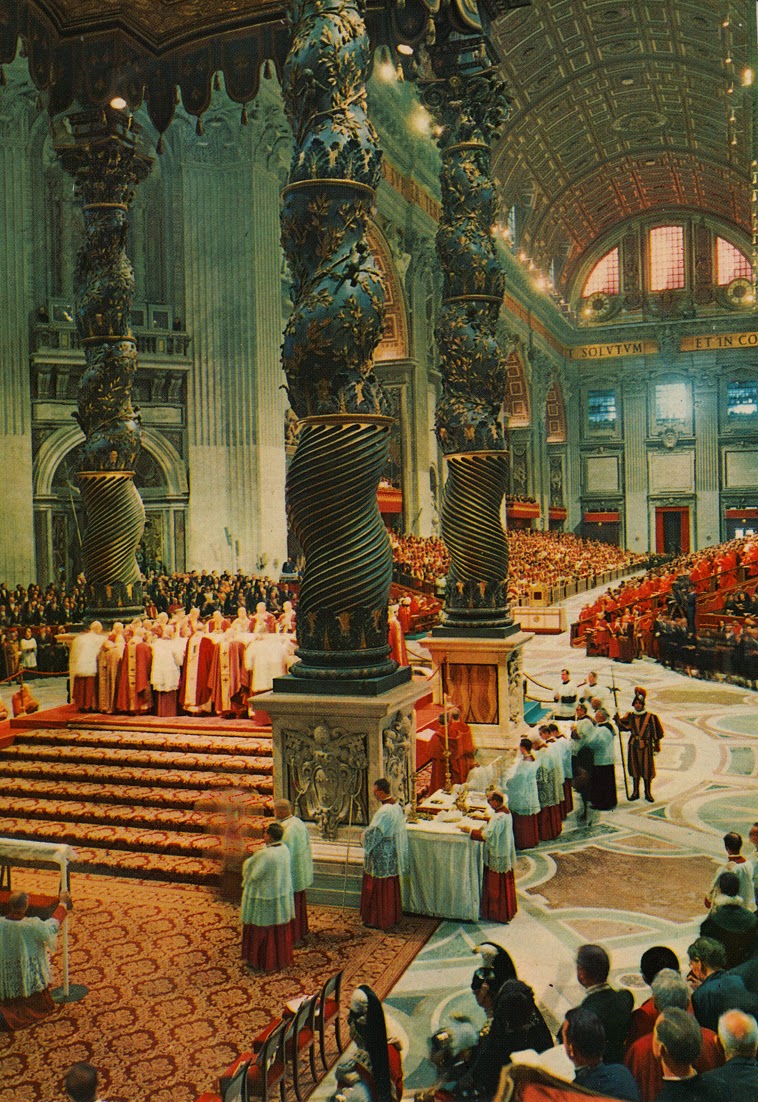
Papal Mass in Saint Peter's 1965

Adjacent is a rather rare photograph, taken in Saint Peter's during a Session of the Second Vatican Council.

Standing at the centre of the altar is Pope Paul VI and with him, concelebrating bishops. At the Opening of the Third and Fourth Sessions of the Council, which took place on 14th September, 1964 and 14th September, 1965 respectively, Pope Paul concelebrated Mass in the basilica with a select number of the Council Fathers.

This Mass, of course, is being celebrated according to those modifications of the Extraordinary Form of the Roman Rite known colloquially as The Interim Missal. The Rite of concelebration, however, is quite similar to that which is found in the new Missal of 1969.

Nevertheless, the concelebrated Masses celebrated in Saint Peter's before the introduction of the new Missal differed very significantly from those after that date, as is illustrated by this photograph. Although the Basilica on this occasion in 1964 or 1965 was filled with bishops, archbishops and cardinals from all around the world, only a small number concelebrated with the Pope.

These concelebrants were standing at the altar during the Canon and Communion Rite. To facilitate this, a temporary enlargement of the altar of the Confession was made, together with platforms on which the concelebrants would stand.

It was of little importance that the concelebrants obscured the congregation's view of the principal celebrant, the Pope. The most important considerations, therefore, were that the concelebrants stood at the altar in close proximity to each other (and the principal celebrant) AND that they could clearly look upon the elements to be consecrated.

Click on the images for an enlarged view.


Sunday, 3 November 2013

Papal Ferula

On the Solemnity of All the Saints, Pope celebrated Mass at the gateway of the Campo Verano Cemetery in Rome.  On this occasion, the Pope used a new ferula, or staff.

It seems the staff was donated by the Italian Goldlake Mining Corporation and that metals for the staff came from Argentina and Honduras.

The staff is purported to depict the Resurrected Christ.