 The Latin Mass Community of Saint Aloysius, Caulfield North (Archdiocese of Melbourne), commissioned the Saint Bede Studio to design and make sets of white vestments. One of the sets is shewn in the adjacent photograph. Made from a cream-coloured brocade and fully-lined, this chasuble is ornamented with a cotton braid of Indian origin. This 3cm-wide braid was arranged in parallel lines to form the orphrey and highlighted with stripes of a scarlet and straw-coloured braid.

Tuesday, 20 November 2007
Usus Antiquior
The Latin Mass Community of Saint Aloysius, Caulfield North (Archdiocese of Melbourne), commissioned the Saint Bede Studio to design and make sets of white vestments. One of the sets is shewn in the adjacent photograph. Made from a cream-coloured brocade and fully-lined, this chasuble is ornamented with a cotton braid of Indian origin. This 3cm-wide braid was arranged in parallel lines to form the orphrey and highlighted with stripes of a scarlet and straw-coloured braid.

Saturday, 17 November 2007
Mitres for Pontifical Masses

Recently, the Saint Bede Studio was commissioned to complete cloth gold mitres for two well-known bishops: His Eminence, George Cardinal Pell, Archbishop of Sydney, and +Msgr. Peter Elliott, auxiliary bishop of Melbourne. These mitres were used at Pontifical Masses celebrated according to the Usus antiquior of the Roman Rite in Saint Mary's Cathedral, Sydney and the Sacred Heart Cathedral, Bendigo. The adjacent photos were taken at those Masses.

The Liturgical Colour "violaceus" in the Roman Rite PART ONE
A subject that has interested me for many years is the question of the colour of the vestments set down to be used in Advent and Lent: purple. Why, I wondered, were there so many variables to be found in this colour amongst vestments, ranging from pink to a dark blue? Recently, having watched a television program about the production of the purple dye as the ancients knew it, I thought that it was worth researching how these colours came to be used for Church vestments. So, this article is the fruit of my research on the use of the liturgical colour violet/purple. Firstly, are the two words violet and purple simply different names for the same colour? Certainly not; Violet is a colour of the spectrum, whereas purple isn’t. In terms of colour definition, violet has definite overtones of blue whereas purple has overtones of red. In this article, a clear distinction is intended to be made when the words "purple" and "violet" are used.
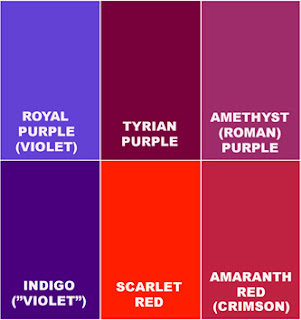 Catholic Prelates (bishops and monsignori) wear vesture of a colour designated by the Church violaceus. In the English-speaking world, we call it Roman Purple; strictly speaking, in terms of colour definitions, this colour is not purple but fuchsia or amethyst. The purple robes of the prelates are trimmed in a colour called Amaranth red (crimson).
Is this Roman purple the colour that the Church intends for vestments in the Seasons of Lent and Advent and for Funeral Liturgies? Some say yes, some say no. The practice in Rome has varied over the last several hundred years.
The Liturgical Books of the Roman Rite (Extraordinary and Ordinary) - The Roman Missal, The Roman Pontifical, The Ceremonial of Bishops - all use the Latin word violaceus specifying the colour. The same word used to denote the colour of vestments is also used to denote the colour of the vesture of prelates. But the colour described by the word violaceus can be either “violet” or “purple” as we define those colours. There is another Latin word purpura (which strictly translates as “purple”), but this is hardly ever mentioned in the Liturgical books or the works of commentators.
In more recent centuries, Rome has understood the word violaceus as describing Roman Purple. Has it always been so? Not at all. Even as recently as the early 20th century it was common to find prelates (but outside of Rome) in violet rather than purple cassocks etc. This confusion was resolved when the Congregation for Sacred Ceremonial issued the decree De colore violaceo of 24th June 1933 defining the shade of violaceus to be used for the vesture of prelates and left a sample of fabric of that colour with the Secretary of the Congregation for Consistories in Rome as a reference point. I’d imagine it’s still about somewhere. Certainly since then we see a worldwide a greater uniformity in the colour of purple worn by prelates.
This ambiguity around the exact colour that the word violaceus denotes extends back into antiquity. But it should be noted that in Antiquity purpura not violaceus was the term used to describe the colour of purple garments.
Although the earliest archaeological evidence for the origins of purple dyes points to the Minoan civilization in Crete, about 1900 B.C., the ancient land of Canaan (its corresponding Greek name was Phoenicia, which means “land of the purple”) was the centre of the ancient purple dye industry. The city of Tyr in Phoenicia was especially famous for producing the dye; thus the name “Tyrian”. “Tyrian Purple” was produced from the mucus of the hypobranchial gland of various species of marine mollusks, notably the Murex. It is believed that it took some 12,000 shellfish to extract 1.5 grams of the pure dye! It can readily be seen why this labour-intensive process was so expensive.
Because the process for producing dye in this way was lost after the conquest of Constantinople in 1453, there has been much speculation as to the precise colour the process actually produced. The answer is that, because of many variables in the process, it didn’t produce any one colour. Sometimes the colour was the same as the flower “violets”, sometimes very similar to fuchsia. But garments of Tyrian Purple were supposedly produced by double-dyeing the fabric, which gave a darker colour. Consequently, the colour produced in that process wasn’t “purple” as we understand purple: the Roman natural historian Pliny described it as the colour of clotted blood: a dark crimson or even maroon.
 One of the attractions of Tyrian purple was that it was the only colour-fast dye known to the ancients. Furthermore, to the ancients, it wasn’t the just the colour that was important: it was also the prestige that accompanied having garments dyed by this expensive process, something only the wealthy could afford. Purple was a status symbol. In Ancient Rome its use was limited to Emperors, and to a lesser extent, senators, so Tyrian purple also became known as Imperial Purple.
In the late period of the Roman Empire (after the fall of the Western Empire), and after the conquest of Tyr by the Arabs in the 7th century, the Tyrian purple dye became less available in Europe, but still freely available in the Eastern or Byzantine Empire. After the fall of Constantinople in 1453 and until quite recently, producing Tyrian or Imperial purple through the dye of the Murex shellfish became a lost process. In the last 20 years, scholars have successfully re-constructed the process through field experiments.
Centuries before the fall of Constantinople, Europe had already adopted other dyeing processes that produced a colour sometimes known as Royal Purple; this was not the same colour as Tyrian purple, but varied from being a shade a little richer than the colour of the flower violet, to the shade of the precious stone the amethyst. These shades of “purple” continued to be used in Europe into modern times. Other less expensive processes were also adopted to replicate the ancient Tyrian purple colour. We can claim with some certainty, therefore, that there has been a continuous tradition of the use of purple in Rome since ancient times. The last remnant of its use in Rome is the Pope’s winter mozetta (see adjacent picture): it is of a shade close to Tyrian purple, even though it is not dyed according to the ancient process.
 Before the 20th century, whether the shade of violaceus was closer to violet or purple (the result of many variables) in any given garment was unlikely to have been considered of any consequence. The technological advances of the 19th century permitted dyes to be produced with a greater accuracy than hitherto. A darker version of violet – more like Indigo in the colour spectrum– came to be used for vestments, especially outside of Rome. Thus it was that a sharp difference between the two colours violet and purple emerged. At this time (and up until the post-Vatican II period), Rome continued to use a lighter shade (closer to amethyst-purple) for the vestments of penitential liturgies.
PART TWO FOLLOWS.
 Catholic Prelates (bishops and monsignori) wear vesture of a colour designated by the Church violaceus. In the English-speaking world, we call it Roman Purple; strictly speaking, in terms of colour definitions, this colour is not purple but fuchsia or amethyst. The purple robes of the prelates are trimmed in a colour called Amaranth red (crimson).
Is this Roman purple the colour that the Church intends for vestments in the Seasons of Lent and Advent and for Funeral Liturgies? Some say yes, some say no. The practice in Rome has varied over the last several hundred years.
The Liturgical Books of the Roman Rite (Extraordinary and Ordinary) - The Roman Missal, The Roman Pontifical, The Ceremonial of Bishops - all use the Latin word violaceus specifying the colour. The same word used to denote the colour of vestments is also used to denote the colour of the vesture of prelates. But the colour described by the word violaceus can be either “violet” or “purple” as we define those colours. There is another Latin word purpura (which strictly translates as “purple”), but this is hardly ever mentioned in the Liturgical books or the works of commentators.
In more recent centuries, Rome has understood the word violaceus as describing Roman Purple. Has it always been so? Not at all. Even as recently as the early 20th century it was common to find prelates (but outside of Rome) in violet rather than purple cassocks etc. This confusion was resolved when the Congregation for Sacred Ceremonial issued the decree De colore violaceo of 24th June 1933 defining the shade of violaceus to be used for the vesture of prelates and left a sample of fabric of that colour with the Secretary of the Congregation for Consistories in Rome as a reference point. I’d imagine it’s still about somewhere. Certainly since then we see a worldwide a greater uniformity in the colour of purple worn by prelates.
This ambiguity around the exact colour that the word violaceus denotes extends back into antiquity. But it should be noted that in Antiquity purpura not violaceus was the term used to describe the colour of purple garments.
Although the earliest archaeological evidence for the origins of purple dyes points to the Minoan civilization in Crete, about 1900 B.C., the ancient land of Canaan (its corresponding Greek name was Phoenicia, which means “land of the purple”) was the centre of the ancient purple dye industry. The city of Tyr in Phoenicia was especially famous for producing the dye; thus the name “Tyrian”. “Tyrian Purple” was produced from the mucus of the hypobranchial gland of various species of marine mollusks, notably the Murex. It is believed that it took some 12,000 shellfish to extract 1.5 grams of the pure dye! It can readily be seen why this labour-intensive process was so expensive.
Because the process for producing dye in this way was lost after the conquest of Constantinople in 1453, there has been much speculation as to the precise colour the process actually produced. The answer is that, because of many variables in the process, it didn’t produce any one colour. Sometimes the colour was the same as the flower “violets”, sometimes very similar to fuchsia. But garments of Tyrian Purple were supposedly produced by double-dyeing the fabric, which gave a darker colour. Consequently, the colour produced in that process wasn’t “purple” as we understand purple: the Roman natural historian Pliny described it as the colour of clotted blood: a dark crimson or even maroon.
 One of the attractions of Tyrian purple was that it was the only colour-fast dye known to the ancients. Furthermore, to the ancients, it wasn’t the just the colour that was important: it was also the prestige that accompanied having garments dyed by this expensive process, something only the wealthy could afford. Purple was a status symbol. In Ancient Rome its use was limited to Emperors, and to a lesser extent, senators, so Tyrian purple also became known as Imperial Purple.
 In the late period of the Roman Empire (after the fall of the Western Empire), and after the conquest of Tyr by the Arabs in the 7th century, the Tyrian purple dye became less available in Europe, but still freely available in the Eastern or Byzantine Empire. After the fall of Constantinople in 1453 and until quite recently, producing Tyrian or Imperial purple through the dye of the Murex shellfish became a lost process. In the last 20 years, scholars have successfully re-constructed the process through field experiments.
Centuries before the fall of Constantinople, Europe had already adopted other dyeing processes that produced a colour sometimes known as Royal Purple; this was not the same colour as Tyrian purple, but varied from being a shade a little richer than the colour of the flower violet, to the shade of the precious stone the amethyst. These shades of “purple” continued to be used in Europe into modern times. Other less expensive processes were also adopted to replicate the ancient Tyrian purple colour. We can claim with some certainty, therefore, that there has been a continuous tradition of the use of purple in Rome since ancient times. The last remnant of its use in Rome is the Pope’s winter mozetta (see adjacent picture): it is of a shade close to Tyrian purple, even though it is not dyed according to the ancient process.
 Before the 20th century, whether the shade of violaceus was closer to violet or purple (the result of many variables) in any given garment was unlikely to have been considered of any consequence. The technological advances of the 19th century permitted dyes to be produced with a greater accuracy than hitherto. A darker version of violet – more like Indigo in the colour spectrum– came to be used for vestments, especially outside of Rome. Thus it was that a sharp difference between the two colours violet and purple emerged. At this time (and up until the post-Vatican II period), Rome continued to use a lighter shade (closer to amethyst-purple) for the vestments of penitential liturgies.
PART TWO FOLLOWS.
The Liturgical Colour violaceus in the Roman Rite PART TWO
Updated 2nd December.
In the twelfth century, Pope Innocent III was the first to specify the colours of the vestments that were to be used for the Roman Rite; almost certainly this reflected prevailing custom in Rome, not an invention on his part. Although a separate subject from this article, it is well to remember that it was only towards the end of the 1st Millenium that the question of vestment colour became a significant one.Black was designated for penitential and funeral liturgies, but violaceus was indicated as a substitute for black. Pope Innocent’s treatise De sacro altaris mysterio (Book I, chapter 65, which was written before his election as pope in 1198) seems to be the first indication that violaceus had come to be regarded as a penitential colour for the Roman Rite.
If the Royal Purple colour which emerged in Late Antiquity Europe as a substitute for Tyrian Purple incorporated what Innocent III refers to as violaceus how did it come to be regarded as a colour of Penance rather than Status? The answer to that is not clear. Extensive research is needed into how the word violaceus was used in Late Antiquity. We do know that the flowers we know as violets were known in antiquity and that the words viola and violarium described the flower, violaceus being an adjective derived from those nouns.
So, what colour is indicated by Innocent’s use of the word violaceus? Let’s consider that question differently: not what the colour was, but what process was used to produce the colour.
 It is likely that at this time (12th century) Tyrian or Imperial purple was still being used in Rome, but it had become the colour used exclusively by the Pope and by nobility. So, when Innocent used the word violaceus, instead of purpura, it would seem very unlikely that he was recommending that violaceus-coloured vestments were to be dyed from the expensive process for producing Tyrian purple. That expensive process would be unaffordable and unavailable to Western clergy. Rather, it would seem likely that Innocent’s violaceus was intended as Royal purple , a colour produced from the less expensive non-Murex dyes. It should be carefully noted that these less expensive dyeing processes could produce a violet-coloured dye or an amethyst (or fuchsia) purple coloured dye. But they were colours not so dark as Tyrian purple. I would suggest, therefore, that Innocent’s use of the word violaceus has nothing to do with an attempt to make a distinction (as some scholars have suggested) between the colours we recognise as violet and purple.
Whilst I suggest that it is an error to interpret Innocent’s violaceus as intending only the colour violet as we recognise it today, it should also be noted that his treatise in a separate section (Chapter 32) discusses the use of the Mosaic colours (cf Exodus 28:5) scarlet, flax-gold, blue and purple, the latter which Innocent describes as signifying the authority and royal dignity of a bishop. In short, purpura still had the connotation of prestige in the time of Innocent III (quite distinct from a penitential use).
I would add that it is certain that Innocent’s violaceus was not the dark violet-blue colour indigo which is commonly understood today as liturgical violet. Indigo, an ancient colour, was a blue quite distinct from violet or amethyst purple. Furthermore, it was not a commonly-used colour in Europe until the 16th century, when it came to be imported from India (hence the name Indigo).
After the fall of Constantinople in 1453, the supply of the Murex shell to produce Tyrian purple dye disappeared. So, in 1464 Pope Paul II authorised an alternative method of production of purple dye, extracted from the cochineal insect. Some scholars have suggested that the purple of the cochineal was much closer in hue to what we call purple and led to our modern conception of purple being a mixture of red and blue. As we have seen, the “purple” Tyrian was dark crimson because of double-dyeing. Others have suggested that Paul II's colour was closer to what we know as the scarlet used by Cardinals. Further investigation of this is required.
 Even after Paul II’s introduction of the new process for dyeing, the colours violet and purple continued to be interchanged indiscriminately throughout the Western church for penitential vestments and the robes of bishops up until the 19th century. The 17th century painting of the prelate Ottaviano Prati shows that his vesture is of violet rather than the fuchsia-purple that we are now familiar with.
From the 19th century, as the process of dyeing fabric became more refined, that shade which the Church designated “purple” became more specific. Even so (as mentioned earlier in the article), it was not until 1933 that Rome specified the shade of purple that was to be used for the robes of its prelates.
A darker version of violet – closer to indigo – became more common in Europe in the 19th century and soon crept into the usage of the Church. Rome resisted this innovation until after the Vatican Council, but we have seen Popes over the last 35 years wearing this Indigo-colour during Lent: a dark colour to reflect a penitential mood.
To conclude, a little summary. The word violaceus used in the ceremonial books of the Roman Rite indicates the colour purple (reddish hues) or violet (bluish hues): the Church does not define the shade violaceus as it applies to sacred vestments. But the Church does define the shade violaceus for the robes of its prelates. Both the reddish purple and the bluish “purple” are colours that have been traditionally used for sacred vestments in the Roman Rite since at least the 12th century. There is a well-established usage in the Church’s Traditions for Tyrian purple, violet and amethyst purple (or fuchsia). But of all the shades of “violaceus” currently in use throughout the Roman Rite, Indigo or dark violet has the least claim to Tradition.
 The ceremonial books of the Roman Rite make no distinction between the shade of violaceus for the vestments that are to be worn in Advent, Lent or for funerals.
On the other hand, those books do not prohibit variations, which might enhance symbolism in a particular Season. In other words, the one shade of “violaceus” is not required to be used for Lent, Advent and for Funerals. In more recent years, for example, the Pope has worn indigo-violet in Lent and purple in Advent. In the United States, some liturgists advocate the opposite practice. In Australia, the colour of the violet flower is used in many dioceses for Advent. Since the Church gives latitude on these matters, we are on safe ground when we choose these shades for liturgical use. We are not on safe ground, however, when we insist that a particular shade is the colour that the Church intends. The history of the use of these colours reveals that they were used freely, without specific regulation, right up until our own times.
Some views of my own on these matters, and they are no more than that: views.
For the Ordinary form of the Roman Rite, when red vestments are required to be used for Palm Sunday and Good Friday, I would like to suggest that it is perfectly permissible and even desirable to use that blood red colour which the ancients referred to as Tyrian Purple. Dare I suggest that this purple is also the appropriate colour for Palm Sunday and Good Friday in the Usus Antiquior of the Roman Rite? I risk being accused of archaeologism, of course.
Then, there is the Season in the Usus Antiquior of the Roman Rite called “Septuagesima”. Is it desirable that the importance of the Season of Lent (from Ash Wednesday onward) be enhanced by the use of vestments of a different colour from the colour used in Septuagesima? We know this is the case in the Sarum and other uses, where a special “Lenten Array” of unbleached linen was used specifically for Lent.
I would like to acknowledge assistance from Inge Boesken Kanold and Dr Gerhard Steigerwald, scholars of the history of the colour purple, in the preparation of this article.
In the twelfth century, Pope Innocent III was the first to specify the colours of the vestments that were to be used for the Roman Rite; almost certainly this reflected prevailing custom in Rome, not an invention on his part. Although a separate subject from this article, it is well to remember that it was only towards the end of the 1st Millenium that the question of vestment colour became a significant one.Black was designated for penitential and funeral liturgies, but violaceus was indicated as a substitute for black. Pope Innocent’s treatise De sacro altaris mysterio (Book I, chapter 65, which was written before his election as pope in 1198) seems to be the first indication that violaceus had come to be regarded as a penitential colour for the Roman Rite.
If the Royal Purple colour which emerged in Late Antiquity Europe as a substitute for Tyrian Purple incorporated what Innocent III refers to as violaceus how did it come to be regarded as a colour of Penance rather than Status? The answer to that is not clear. Extensive research is needed into how the word violaceus was used in Late Antiquity. We do know that the flowers we know as violets were known in antiquity and that the words viola and violarium described the flower, violaceus being an adjective derived from those nouns.
So, what colour is indicated by Innocent’s use of the word violaceus? Let’s consider that question differently: not what the colour was, but what process was used to produce the colour.
 It is likely that at this time (12th century) Tyrian or Imperial purple was still being used in Rome, but it had become the colour used exclusively by the Pope and by nobility. So, when Innocent used the word violaceus, instead of purpura, it would seem very unlikely that he was recommending that violaceus-coloured vestments were to be dyed from the expensive process for producing Tyrian purple. That expensive process would be unaffordable and unavailable to Western clergy. Rather, it would seem likely that Innocent’s violaceus was intended as Royal purple , a colour produced from the less expensive non-Murex dyes. It should be carefully noted that these less expensive dyeing processes could produce a violet-coloured dye or an amethyst (or fuchsia) purple coloured dye. But they were colours not so dark as Tyrian purple. I would suggest, therefore, that Innocent’s use of the word violaceus has nothing to do with an attempt to make a distinction (as some scholars have suggested) between the colours we recognise as violet and purple.
 Whilst I suggest that it is an error to interpret Innocent’s violaceus as intending only the colour violet as we recognise it today, it should also be noted that his treatise in a separate section (Chapter 32) discusses the use of the Mosaic colours (cf Exodus 28:5) scarlet, flax-gold, blue and purple, the latter which Innocent describes as signifying the authority and royal dignity of a bishop. In short, purpura still had the connotation of prestige in the time of Innocent III (quite distinct from a penitential use).
I would add that it is certain that Innocent’s violaceus was not the dark violet-blue colour indigo which is commonly understood today as liturgical violet. Indigo, an ancient colour, was a blue quite distinct from violet or amethyst purple. Furthermore, it was not a commonly-used colour in Europe until the 16th century, when it came to be imported from India (hence the name Indigo).
After the fall of Constantinople in 1453, the supply of the Murex shell to produce Tyrian purple dye disappeared. So, in 1464 Pope Paul II authorised an alternative method of production of purple dye, extracted from the cochineal insect. Some scholars have suggested that the purple of the cochineal was much closer in hue to what we call purple and led to our modern conception of purple being a mixture of red and blue. As we have seen, the “purple” Tyrian was dark crimson because of double-dyeing. Others have suggested that Paul II's colour was closer to what we know as the scarlet used by Cardinals. Further investigation of this is required.
 Even after Paul II’s introduction of the new process for dyeing, the colours violet and purple continued to be interchanged indiscriminately throughout the Western church for penitential vestments and the robes of bishops up until the 19th century. The 17th century painting of the prelate Ottaviano Prati shows that his vesture is of violet rather than the fuchsia-purple that we are now familiar with.
From the 19th century, as the process of dyeing fabric became more refined, that shade which the Church designated “purple” became more specific. Even so (as mentioned earlier in the article), it was not until 1933 that Rome specified the shade of purple that was to be used for the robes of its prelates.
A darker version of violet – closer to indigo – became more common in Europe in the 19th century and soon crept into the usage of the Church. Rome resisted this innovation until after the Vatican Council, but we have seen Popes over the last 35 years wearing this Indigo-colour during Lent: a dark colour to reflect a penitential mood.
To conclude, a little summary. The word violaceus used in the ceremonial books of the Roman Rite indicates the colour purple (reddish hues) or violet (bluish hues): the Church does not define the shade violaceus as it applies to sacred vestments. But the Church does define the shade violaceus for the robes of its prelates. Both the reddish purple and the bluish “purple” are colours that have been traditionally used for sacred vestments in the Roman Rite since at least the 12th century. There is a well-established usage in the Church’s Traditions for Tyrian purple, violet and amethyst purple (or fuchsia). But of all the shades of “violaceus” currently in use throughout the Roman Rite, Indigo or dark violet has the least claim to Tradition.
 The ceremonial books of the Roman Rite make no distinction between the shade of violaceus for the vestments that are to be worn in Advent, Lent or for funerals.
 On the other hand, those books do not prohibit variations, which might enhance symbolism in a particular Season. In other words, the one shade of “violaceus” is not required to be used for Lent, Advent and for Funerals. In more recent years, for example, the Pope has worn indigo-violet in Lent and purple in Advent. In the United States, some liturgists advocate the opposite practice. In Australia, the colour of the violet flower is used in many dioceses for Advent. Since the Church gives latitude on these matters, we are on safe ground when we choose these shades for liturgical use. We are not on safe ground, however, when we insist that a particular shade is the colour that the Church intends. The history of the use of these colours reveals that they were used freely, without specific regulation, right up until our own times.
Some views of my own on these matters, and they are no more than that: views.
For the Ordinary form of the Roman Rite, when red vestments are required to be used for Palm Sunday and Good Friday, I would like to suggest that it is perfectly permissible and even desirable to use that blood red colour which the ancients referred to as Tyrian Purple. Dare I suggest that this purple is also the appropriate colour for Palm Sunday and Good Friday in the Usus Antiquior of the Roman Rite? I risk being accused of archaeologism, of course.
Then, there is the Season in the Usus Antiquior of the Roman Rite called “Septuagesima”. Is it desirable that the importance of the Season of Lent (from Ash Wednesday onward) be enhanced by the use of vestments of a different colour from the colour used in Septuagesima? We know this is the case in the Sarum and other uses, where a special “Lenten Array” of unbleached linen was used specifically for Lent.
I would like to acknowledge assistance from Inge Boesken Kanold and Dr Gerhard Steigerwald, scholars of the history of the colour purple, in the preparation of this article.
Friday, 12 October 2007
Funeral Liturgy Vestments
From time to time, discussions comes up on various Blogs about the colour of vestments to be used for Funeral Liturgies. The General Instruction on the Roman Missal sets down that purple (violaceus) vestments should be worn, but black or white vestments may be used where it is customary. For the Extraordinary form of the Roman Rite, black vestments are to be used.
Of course, it has become commonplace throughout much of the Church that white vestments are the standard fare for funerals. Here, I don't wish to comment on the arguments for and against this usage (though it is a practice I personally dislike).
Instead, I would like to comment that if white vestments are to be used for funerals, they should be decidely different from Festal vestments. Rather than being ornamental, they should be restrained, even sombre: characterised by simplicity. The Holy Rood Guild supplies such white sets as a standard fare: a simple cream-coloured chasuble, ornamented with orphreys of dark purple. They supply a funeral pall to match.
At the moment, the Saint Bede Studio is working on a project to develop a chasuble for Funeral liturgies that is white, but decorated in black and gold. For this design, the use of black is very limited, so that there is not a clash of extremes. I also feel it is important to highlight that such sets of vestments are not intended for festal use, by making them of plain fabrics (wool, unbleached linen or raw silk), rather than a brocade or damask.
A photograph of the completed vestment will be posted on this Blog in the next several weeks.
Of course, it has become commonplace throughout much of the Church that white vestments are the standard fare for funerals. Here, I don't wish to comment on the arguments for and against this usage (though it is a practice I personally dislike).
Instead, I would like to comment that if white vestments are to be used for funerals, they should be decidely different from Festal vestments. Rather than being ornamental, they should be restrained, even sombre: characterised by simplicity. The Holy Rood Guild supplies such white sets as a standard fare: a simple cream-coloured chasuble, ornamented with orphreys of dark purple. They supply a funeral pall to match.
At the moment, the Saint Bede Studio is working on a project to develop a chasuble for Funeral liturgies that is white, but decorated in black and gold. For this design, the use of black is very limited, so that there is not a clash of extremes. I also feel it is important to highlight that such sets of vestments are not intended for festal use, by making them of plain fabrics (wool, unbleached linen or raw silk), rather than a brocade or damask.
A photograph of the completed vestment will be posted on this Blog in the next several weeks.
Monday, 24 September 2007
Just a question of taste?
After my posting about differing styles of vestments, I received a number of e-mails, mostly those thanking me for raising these issues. Others, however, responded in a manner that was (frankly) near-hysterical. That people feel so passionate as to react in such a manner is a topic worthy of some discussion. And so, I have been asked to write a little more on these subjects.
It has been put to me that the question of the style of vestments is purely one of taste; that “Roman” vestments represent an organic development of the Church’s liturgy and accordingly might not be questioned; and that the Traditions that people love should not be mocked.
So, I would like to answer these particular questions. It may be that whether one likes or dislikes “Roman” vestments is a matter of taste. But that wasn’t the point of my original post. My point was this: why is there an almost automatic association between Roman vestments, lace albs etc and the Old Mass? Unhappily, there is most certainly an attitude floating around in the circles of Catholic Tradition that this Baroque expression of the Old Mass is THE valid expression. Consequently (I assure you I am not caricaturing this view), using styles of vestments that are older or more modern than that of the Baroque, is regarded with suspicion and even hostility. People should be aware that there are priests who refuse to wear more ample vestments because they regard them as antithetical to Tradition (there are also priests who prefer Roman vestments because they give a greater freedom of movement for the arms; that, of course, is a separate issue).
For me, this is quite a disturbing attitude. It is an attitude that ought to be examined critically, because it is a very narrow interpretation of the concept of Tradition. It is not adequate to assert that the use of Roman vestments and lace may not be subject to question because they are “Traditional”.
Exactly why is there such an attachment to this Baroque expression of Tradition? This, I suspect is a question which cuts to the heart of people’s perception of the nature of Tradition. It is a sociological issue also, which I am not qualified to comment on. Somebody put to me once that many people were greatly upset and even scandalised when Papal Rome made a wholesale rejection of the Baroque in the late 1960’s. The array of Papal ceremonial was replaced with something very functional and austere: somewhat like the ethos of the 1960’s itself. Consequently, and for precisely this reason, there is a very negative attitude amongst some to modern expressions in the style of vestments. Had 1960’s Rome decided to use beautiful damasks for the Papal vestments instead of the plainest of silk, perhaps attitudes might have been different.
Perhaps those who were born after that era and whose experience of vestments has been the often uninspired, sometimes hideous products of the major Church suppliers find the beautiful damasks and ornamentation of the Roman chasuble quite attractive in their richness and in their differentness. There is also a certain fascination with this style of vestment. And there is the concept that is once again becoming most important: using vestments of magnificence for the worship of God.
 The photograph I have attached shews the Benedictine Abbot of Le Barroux offering Mass in the Monastery church of Sainte-Marie de la Garde (Saint Perre De Clairac, France) a foundation of Le Barroux. The vestments are very rich and, although obviously inspired by ancient forms, are nevertheless modern in presentation. They were made for and only used for the Old Mass.
In future articles, I hope to discuss what the essence of a vestment is and why it is desirable to strike a balance between the form of the vestment and its ornament. I will also discuss various misconceptions about past statements of the Congregation of Rites on the use of "Gothic" versus "Roman" vestments. And, I will tackle thorny questions such as why these issues are not just a question of taste and why the "organic development" assertion is a not an adequate argument in discussing styles of vestments.
It has been put to me that the question of the style of vestments is purely one of taste; that “Roman” vestments represent an organic development of the Church’s liturgy and accordingly might not be questioned; and that the Traditions that people love should not be mocked.
So, I would like to answer these particular questions. It may be that whether one likes or dislikes “Roman” vestments is a matter of taste. But that wasn’t the point of my original post. My point was this: why is there an almost automatic association between Roman vestments, lace albs etc and the Old Mass? Unhappily, there is most certainly an attitude floating around in the circles of Catholic Tradition that this Baroque expression of the Old Mass is THE valid expression. Consequently (I assure you I am not caricaturing this view), using styles of vestments that are older or more modern than that of the Baroque, is regarded with suspicion and even hostility. People should be aware that there are priests who refuse to wear more ample vestments because they regard them as antithetical to Tradition (there are also priests who prefer Roman vestments because they give a greater freedom of movement for the arms; that, of course, is a separate issue).
For me, this is quite a disturbing attitude. It is an attitude that ought to be examined critically, because it is a very narrow interpretation of the concept of Tradition. It is not adequate to assert that the use of Roman vestments and lace may not be subject to question because they are “Traditional”.
Exactly why is there such an attachment to this Baroque expression of Tradition? This, I suspect is a question which cuts to the heart of people’s perception of the nature of Tradition. It is a sociological issue also, which I am not qualified to comment on. Somebody put to me once that many people were greatly upset and even scandalised when Papal Rome made a wholesale rejection of the Baroque in the late 1960’s. The array of Papal ceremonial was replaced with something very functional and austere: somewhat like the ethos of the 1960’s itself. Consequently, and for precisely this reason, there is a very negative attitude amongst some to modern expressions in the style of vestments. Had 1960’s Rome decided to use beautiful damasks for the Papal vestments instead of the plainest of silk, perhaps attitudes might have been different.
Perhaps those who were born after that era and whose experience of vestments has been the often uninspired, sometimes hideous products of the major Church suppliers find the beautiful damasks and ornamentation of the Roman chasuble quite attractive in their richness and in their differentness. There is also a certain fascination with this style of vestment. And there is the concept that is once again becoming most important: using vestments of magnificence for the worship of God.
 The photograph I have attached shews the Benedictine Abbot of Le Barroux offering Mass in the Monastery church of Sainte-Marie de la Garde (Saint Perre De Clairac, France) a foundation of Le Barroux. The vestments are very rich and, although obviously inspired by ancient forms, are nevertheless modern in presentation. They were made for and only used for the Old Mass.
In future articles, I hope to discuss what the essence of a vestment is and why it is desirable to strike a balance between the form of the vestment and its ornament. I will also discuss various misconceptions about past statements of the Congregation of Rites on the use of "Gothic" versus "Roman" vestments. And, I will tackle thorny questions such as why these issues are not just a question of taste and why the "organic development" assertion is a not an adequate argument in discussing styles of vestments.
Saturday, 22 September 2007
SUMMORUM PONTIFICUM:
Looking forward, not back

As a devotee of the Old Mass (now to be referred to as the Extraordinary Form or More Ancient Use of the Roman Rite) since boyhood, the promulgation of Pope Benedict's motu proprio has been an occasion of the greatest joy for me. But what I have seen since the announcement has made me pause to reflect. Is Summorum Pontificum a document that intends to make Tradition anew for the future, or a document that wishes to re-create the past? This issue is, in fact, a tension that has been manifest in the Old Mass movement all along.
For my part, Summorum Pontificum is not only about clarifying the status of the Old Mass; I believe it is also intended as a means to reform the degenerate state into which the Church's Liturgy has fallen. The revival of the Old Mass is intended to enrich the Church: our ancient Traditions are never more needed. But this doesn't require our getting into a time machine back to 1950 or 1750. When I saw a headline on the internet Return of Latin mass sparks old vestment hunt, I felt slightly uneasy. What I have seen since 14th September has made me very uneasy: an explosion of pictures on the internet of the celebration of the Old Mass, almost all of them shewing lacey albs, fiddleback chasubles, birettas, baroque mitres etc etc. It's as if suddenly the doors of a lolly shop were broken down and everyone has got in to gorge themselves.
 These are the questions I wish to pose to the Old Mass Movement: Do people believe that the true expression of the Old Mass must be with Baroque styles of vestments? If so, why? Is this Tradition or Re-creation?
 This blog was not intended for philosophical debate, but about issues concerning the Liturgy and specifically Sacred vestments and architecture. So, I attach two photos to this post of Pontifical celebrations of the Old Mass. In one, the Cardinal-President of the Ecclesia Dei Commission and his assistants are vested in a frightful dark red set of 18th century "Roman" vestments (but certainly a very beautiful cope is also pictured); in the other, a French bishop celebrates an Ordination at the Benedictine Abbey of Fontgombault in 2004. Celebrant and ministers are vested in a beautiful early 20th century set of red Gothic revival vestments. The contrast between these two expressions of Tradition is overwhelming.
Monday, 3 September 2007
S' Philip Neri: 16th century chasuble


The Saint Bede Studio has now received a number of orders for chasubles according to the style of the 16th century. Chasubles of this period, whilst having the decorative features of the later "fiddleback" chasubles of the 18th century, were much longer and wider than the 18th century form. Sometimes this 16th century cut of chasuble is referred to as the style of S' Philip Neri, because there are several portraits of the Saint wearing just such vestments (see adjacent picture).
Although this cut of chasuble has never completely disappeared, in more recent times there appears to be a revived interest. This can be observed in photographs of various Masses celebrated by the Fathers of the Priestly Fraternity of Saint Peter in Witgratzbad (see adjacent pictures).
The style illustrated in the pictures is the Italianate style. Another form existed in Catholic England at this time, which was more pointed at the front, slightly wider and employed a narrower stole and maniple. This was similar to the form revived by Pugin and others in the first half of the 19th century.
Saturday, 18 August 2007
Pugin-inspired Braids

The Saint Bede Studio is pleased to announce the release of the first of a series of vestment braids after the style of AWN Pugin. The first of these braids (width 8cm) is shewn in the adjacent picture and is old gold on crimson red. The genius of Pugin was such that he conceived a braid which would happily ornament all the liturgical colours: White, Green, Red, Violet and Black. Pugin's original braid (in the same colours, crimson and gold), designed in the 1840's, may be familiar to readers and a form of it is still available from English manufacturers (with the unhappy addition of lurex thread). The Saint Bede Studio braid, however, is an original design, based upon Pugin's work, not a copy of it. The designs for this new series of Puginesque braids will be protected under international law.
The Colour (Color) Purple: part one


Some months ago, I had an online discussion about the difference between the colours purple and violet. In descriptive terms, violet is tinged with blue; purple is tinged with red. So, when the Church’s ceremonial books cite the colour "violaceus" (a Latin word), which colour is meant: violet or purple? There is no definitive answer to this, since the word itself can mean either purple or violet. See the problem? We know that the vesture of bishops is of a colour we call Roman purple. Is this the colour intended for sacred vestments in the Seasons of Lent and Advent? Some say yes, some say no. The practice throughout the world and in Rome itself has differed over the course of the last several centuries.
Let’s try to distinguish the uses of the colour "violaceus". The colour of vestments in Advent and Lent is intended to be penitential and sombre. The purple of bishops, however, is intended to be a mark of their rank, and is derived from the ancient use (by the Romans) of purple robes to denote dignity, prestige and royalty. Thus, that purple is not intended to be penitential.
Do we know what the ancient colour purple was? Until recently, no. But because of the research of English chemist John Edmonds and German artist Inge Boesken Kanold (go to website) we do now have a better idea. It is well known that the purple dye was made from the murex shellfish, which were obtained in ancient times from the seaport of Tyre. Did these shellfish produce a single, specific colour? Evidently not, because it depended on the shellfish which was used. One thing that can be said was that the dye produced by these shellfish was a rich, not a sombre colour. As to the hue? There is evidence of the shellfish producing both purple (similar to the colour of the robes of modern bishops) and also the colour of the flower violets.
In a separate article, I will try to deal with the question of when violaceus came to be designated as a pentitential colour (relatively recently) for liturgical use.
Subscribe to:
Posts (Atom)