Saturday, 10 April 2010

Holy Week in Melbourne (part three)

We continue our series of photographs from the Latin Mass Community at Saint Aloysius' Church, Caulfield North (Archdiocese of Melbourne) of the rites of Holy Week. A complete set of photographs can be found here.

As mentioned in our earlier posts, this year, Holy Week was especially significant for the Melbourne Community, since the rites were celebrated by the Most Rev'd Basil Meeking DD, Bishop-emeritus of the Diocese of Christchurch (New Zealand) and well-known supporter of Catholic Tradition. These ceremonies at Caulfield also represent the first occasion since the mid-1960s that the Holy Week rites have been celebrated Pontifically in Australia according to the Extraordinary Form.

In this post, photographs of the Easter Vigil, Easter Day and Easter Monday.

Click on the photograph for an enlarged view.


The Paschal Vigil
At the Lumen Christi
Father Tattersall carrying the Paschal Candle:

The Paschal Vigil
During the Renewal of Baptismal Promises:

Pontifical Mass of Easter Night
At the Consecration:

Pontifical Mass of Easter Night
At the Bishop's Blessing:

Pontifical Mass of Easter Day
During the singing of Terce:

Pontifical Mass of Easter Day
Incensation of the Bishop at the Offertory:

Pontifical Mass of Easter Day
At the Ecce Agnus Dei:

Pontifical Mass of Easter Day
At the Bishop's Blessing:


Pontifical Mass of Easter Monday
At the Offertory
Assistant priest, Father Tattersall;
deacon,Father McDaniels; subdeacon, Father Terence OFM (Conv.):


Pontifical Mass of Easter Monday
Incensation at the Offertory:

Pontifical Mass of Easter Monday
Incensation of the Bishop:

Pontifical Mass of Easter Monday
At the Preface:

Pontifical Mass of Easter Monday
Lavabo after Holy Communion:


Pontifical Mass of Easter Monday
At the Bishop's Blessing:

Thursday, 8 April 2010

Extraordinary Scenes in Melbourne: part two

We are pleased to continue our series of photographs taken by Dr Chris Steward of the Latin Mass Community at Saint Aloysius Church, Caulfield North (Archdiocese of Melbourne) of the rites of Holy Week.

This year, Holy Week is especially significant for the Melbourne Community, since the rites are being celebrated by the Most Rev'd Basil Meeking DD, Bishop-emeritus of the Diocese of Christchurch (New Zealand) and well-known supporter of Catholic Tradition. These ceremonies at Caulfield also represent the first occasion since the mid-1960s that the Holy Week rites have been celebrated Pontifically in Australia according to the Extraordinary Form. May we not hope that what has happened in Melbourne this year may become a common phenomenon world-wide in the years to come?

In this post, photographs of the Bishop's Low Mass on Spy Wednesday; Tenebrae of Maundy Thursday; the Evening Mass of the Lord's Supper on Maundy Thursday, Stations of the Cross on Good Friday, followed by the Solemn Commemoration of the Lord's Suffering and Death.
Link
Note that a complete series of photos can be found here.

Please click on each photo for an enlarged view.

Spy Wednesday in Holy Week: Low Mass of the Bishop
Orate Fratres.

Spy Wednesday in Holy Week: Low Mass of the Bishop
Ecce Agnus Dei
Chaplains to the Bishop Father Terence OFM (Conv) and Father Tattersall.

Maundy Thursday: Tenebrae
Lesson in the 2nd Nocturn
sung by director of the Schola, Nick Dinopoulos.

Maundy Thursday: Tenebrae
Lesson in the 3rd Nocturn
sung by Father Tattersall.

Maundy Thursday: Evening Mass of the Lord's Supper
The Mandatum.

Maundy Thursday: Evening Mass of the Lord's Supper
At the Altar of Repose.

Maundy Thursday: Evening Mass of the Lord's Supper
The Stripping of the Altars.

Good Friday: Stations of the Cross
The Schola at the 1st Station.

Good Friday: Stations of the Cross
The Bishop assisted by Father Terence OFM (Conv).

Good Friday: Commemoration of the Lord's Suffering and Death
The Passion Gospel.

Good Friday: Commemoration of the Lord's Suffering and Death
The Bidding Prayers.

Good Friday: Commemoration of the Lord's Suffering and Death
The Unveiling of the Cross.

Good Friday: Commemoration of the Lord's Suffering and Death
The Communion Rite.

Sunday, 28 March 2010

Holy Week in Melbourne (Extraordinary Form) I

We are pleased to be able to post a series of photographs taken by Dr Chris Steward of the Latin Mass Community at Saint Aloysius Church, Caulfield North (Archdiocese of Melbourne) of the rites of Holy Week. Note that a complete series of photos can be found here.

This year, Holy Week is especially significant for the Melbourne Community, since the rites are being celebrated by the Most Rev'd Basil Meeking DD, Bishop-emeritus of the Diocese of Christchurch (New Zealand) and well-known supporter of Catholic Tradition. These ceremonies at Caulfield also represent the first occasion since 1969 that the Holy Week rites have been celebrated Pontifically in Australia according to the Extraordinary Form.

In this first post, the Palm Sunday rites. Mitres used were made by the Saint Bede Studio. The vestments used in the photographs below, however, were made by the firm of Th. Pijnappel in 's-Hertogenbosch, the Netherlands, 60 years ago for a religious community in Melbourne. They are masterpieces of design.

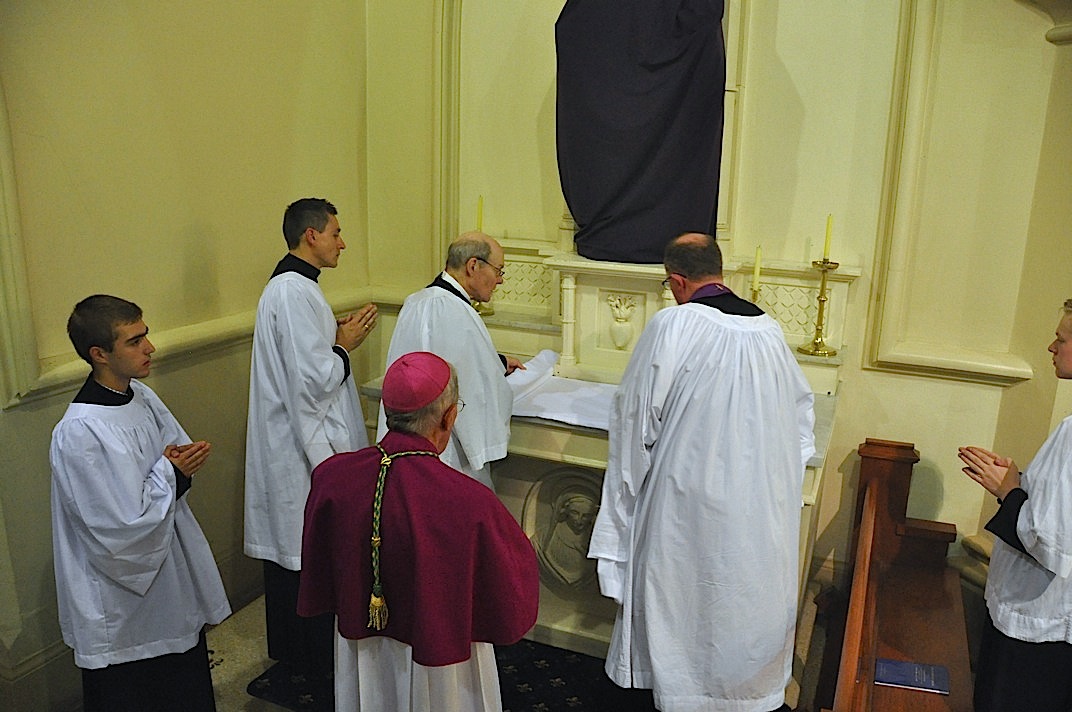
Procession for the Blessing of Palms:


The Bishop distributing the Blessed palms.


The Procession with palms.


The Bishop with sacred ministers during the Procession
(Father Tattersall, assistant priest; Father McDaniels, deacon; Father Terence OFM (Conv.).


Incensation of the Altar at the beginning of the Mass.


Chanting of the Passion Gospel according to S' Matthew.


At the faldstool during the Et Incarnatus est.

At the Elevation.


At the bishop's Blessing.


Click on each photograph for an enlarged view.


Saturday, 6 February 2010

Mitres, part the second.

What should we find on the Blogs today, but a splendid snap by that indefatigable photographer of Catholic Tradition, Tom Kwok. This photograph was taken in the Sacred Heart Cathedral Bendigo during a Pontifical Mass celebrated by the Most Rev'd Peter Elliott, auxiliary bishop of Melbourne, on the Feast of Christ the King, 2008.

Ornamenting His Lordship's head is mitre made by the Saint Bede Studio and presented to him by the Australian Confraternity of Catholic Clergy upon his consecration as a bishop in 2007.

Monday, 1 February 2010

Mitres

This is the first of a series of posts illustrating past projects of the Saint Bede Studio.

Adjacent is a collage of three precious mitres made for some noteworthy clients. On the left is a mitre made for the Archbishop of Adelaide, the Most Rev'd Philip Wilson. Ornament on this mitre was based on a design of AWN Pugin. In the middle is the mitre made for HH Pope Benedict for World Youth Day (Sydney) 2008. The ornament on this mitre was based on the famous mitre of S' Thomas Becket, housed at the Sens Cathedral. On the right, a simpler mitre, made for HE Cardinal Pell, Archbishop of Sydney.

The design of mitres is all too often underestimated or ignored in choosing vestments for a bishop. The use of headgear makes such a notable change to the appearance of a man, that sound consideration needs to be given to the design of a mitre. Mitres of the Saint Bede Studio are custom made. Particular attention is paid to the shape, height and decoration of its mitres in order to make them most appropriate for the wearer.

Enquiries: stbede62@gmail.com

2010

Greetings to all our clients and readers of this Blog.

Our other website - a tired old thing - is undergoing a major revamp. In the meantime, however, there are some temporary changes and improvements.

Note that the Studio website can be visited here.

Photographs on the Studio website now link directly to postings on this Blog. This is a new approach so that the two sites will be interconnected and not two distantly-related entities.

Saturday, 26 December 2009


To all readers of this Blog, friends and customers of the Saint Bede Studio, my best wishes for a Blessed Christmas, filled with the graces of this Holy Season.

Photographs of Christmas Matins celebrated at S' Aloysius Church, Caulfield (Archdiocese of Melbourne, Australia). Photographs taken by Dr Chris Steward.


Tuesday, 22 December 2009

On raising the chasuble at the Elevations

In the celebration of the Extraordinary Form of the Roman Rite, the minister (deacon or altar server) is directed to raise the chasuble slightly in his left hand as the celebrant elevates the Sacred Host and then the Chalice. This direction is given in the Ritus Servandus VIII,8; the Caeremoniale Episcoporum II, viii and a decision of the Congregation of Sacred Rites no 3535.

What is the origin of this practice? It dates from that period when chasubles were voluminous and constrained the celebrant from raising his arms above his head. Lifting the lower right hand corner of the chasuble actually enables the celebrant a greater movement of the arms. Thus, the origin of this ceremonial action is purely practical. Much has been written about mystic and symbolic meanings as being the origin of this action, all of which is complete nonsense.

The ceremonial books direct that the raising of the chasuble be a very subtle action. It was never intended that the chasuble be raised half-way up the celebrant's back or - worse still - be held up by both hands of the minister, making the chasuble seem like some fantastical ecclesiastical sail. Most assuredly such exaggerated movements are distracting both to the celebrant and to the congregation.

If the chasuble is not very ample at all, there is even more reason for its raising at the Elevation to be a very modest action: just a couple of inches at most. Furthermore, this gesture only accompanies the actual Elevations, and not the celebrant's accompanying genuflections.

Attached is a beautiful photograph of a Low Mass celebrated at Prinknash Abbey (UK) in 1940, illustrating perfectly how it should be done.

Tuesday, 15 December 2009

Maria Regina Vestments

The Saint Bede Studio was commissioned by Saint Mary's Parish, Charleston, South Carolina, to prepare a Solemn Mass set of vestments based upon the Maria Regina design. The Pastor of Saint Mary's is also the Rector of the Charleston Cathedral.

The Studio regularly receives enquiries for the Maria Regina chasuble, which is derived from a design of AWN Pugin.

Pictured adjacent are parts of the set: the chasuble, cope and a tunic.

Click on the photographs for enlarged views.

Enquiries: stbede62@gmail.com


Friday, 11 December 2009

A Rose by any other name but pink

Twice a year, the Church breaks the tone of its penitential seasons by the use of rose-coloured vestments. Rose-coloured vestments were never commonplace and they still are not. Nevertheless, you will find various pronouncements these days (usually on websites) about what the real or authentic shade of rose is which is to be used for vestments.

Newsflash: there is no official shade of Rose designated by the Church, nor has there ever been. The reason for this is rather simple: only in the last century did the process of dyeing fabric become sufficiently sophisticated to ensure that much the same shade of a colour emerged from one batch of fabric dyeing to another.

Many different colours have been deemed by the Church as acceptable as liturgical Rose. Some of these are a salmon shade; some a silvery-pink, almost mushroom-colour; some close to what we would call Bishop's purple or fuchsia.

Another thing is certain: Bubblegum Pink is not Rose, nor has it been a traditional variation for use on these days. Whilst not intending to get into the argument as to whether the use of a such a vibrant pink is a fitting colour for a man to wear, Bubblegum Pink certainly manifests a lamentable lack of liturgical good taste.


At the Blog, The New Liturgical Movement, we find a number of interesting vestments in that shade of Rose commonly found in Italy in centuries past: a salmon colour. Go there and take a look.

Adjacent are three pictures of other shades of Rose. One is a set of vestments worn by Pope Paul VI on Laetare Sunday, 1978 (photographs of L'Osservatore Romano). The vestment is made from dupion silk of a very subdued mushroom-pink, with overtones of silver. Ornamenting it is a column almost fuchsia in colour.

The other picture is the cope made by the Saint Bede Studio for the Latin Mass Apostolate in Melbourne. It has overtones of subdued red in it, yet decidedly unlike the colours used for Liturgical Red. This cope is ornamented with a brocade of forest green, and a braid of Gothic foliage ornament.

Another set of Rose vestments made last year by the Studio for the Cathedral of Atlanta, Georgia can be seen here.

Enquiries: stbede62@gmail.com