I was very honoured to be asked by the US-based Catholic artist, Daniel Mitsui, to be interviewed for his well-known website The Lion and the Cardinal.
The interview can be read here.

Tuesday, 28 September 2010
Saturday, 25 September 2010
Vestments for the Season "Per Annum"

Father Mitchell Beachey of Quebec, Canada, a returning customer, commissioned the Studio to prepare a set of green vestments for the Season Per Annum. Father Beachey chose to have the set prepared in the "Philip Neri" style. The vestments were made of a green damask, ornamented in the Roman style with a narrow braid forming the outline of the orphrey.
Enquiries: stbede62@gmail.com
Click on the picture for an enlarged view.

Thursday, 23 September 2010
Conical vestments

Enquiries: stbede62@gmail.com
Click on the picture for a larger view.
Saturday, 14 August 2010
Puginesque vestments in Wallsend
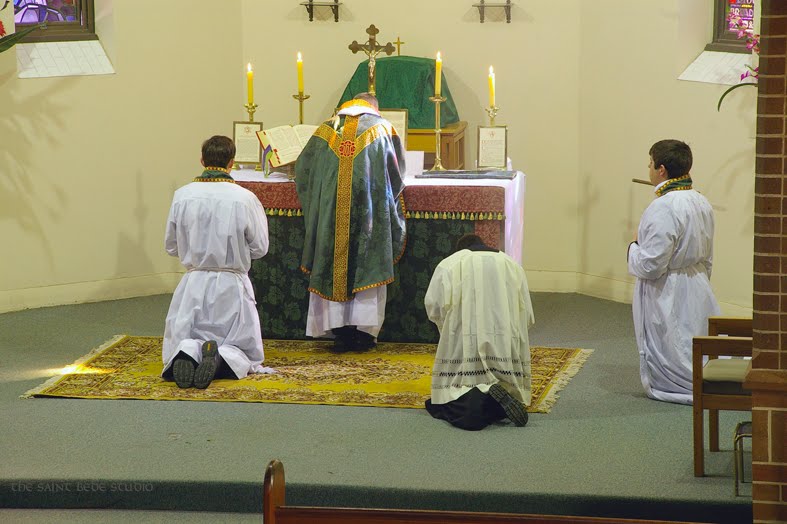
 This post features a chasuble and cope set, with matching antependium, which the Saint Bede Studio has made for the use of the Latin Mass Community in Newcastle (Australia). These vestments have already been used for a Missa Cantata at Saint Patrick's church Wallsend, which has been featured on The New Liturgical Movement and The Hermeneutic of Continuity.
Some photographs are included from the Mass, in addition to a studio image of the cope. A forest green damask was used for these vestments, ornamented with Puginesque braids in red and gold.
Enquiries: stbede62@gmail.com
Click on the images for an enlarged view.

Monday, 2 August 2010
Sundays after Pentecost - part II

These vestments are made from a magnificent damask of green and gold, ornamented simply with an outlining braid, and lined in green cotton.
Click on the picture for an enlarged view.
Enquiries: stbede62@gmail.com
Monday, 26 July 2010
Ordination 2010 - Part V
 The last in this small series of Ordination chasubles is a set of vestments prepared for Father Daniel O'Mullane from the United States who studied for the Sacred Priesthood at the Pontifical North American College, Rome.
Father O'Mullane asked for a Maria Regina chasuble, which has been featured on this blog several times before. Having had two chasubles prepared, Father O'Mullane wrote about his experiences with the Saint Bede Studio:
Working with the Saint Bede Studio has been a truly edifying experience. I am so happy to have found someone in Michael who cares deeply about the Sacred Liturgy, has a discerning eye for beauty in vestments and vesture, and can work well with me to bring my ideas to fruition. Not only are these the finest vestments I have ever worn, they are the finest I have seen in person. The fabrics are top quality, and the workmanship is perfect down to the minutest details. I have thoroughly enjoyed this prayerful process, and I look forward to our next project!
Click on the image for an enlarged view.
Enquiries: stbede62@gmail.com
Sunday, 11 July 2010
Ordinations 2010 - part IV
 The fourth in this small series of Ordination chasubles was prepared for Father Daniel O'Mullane from the United States who studied for the Sacred Priesthood at the Pontifical North American College, Rome.
The ordinand asked for a chasuble which corresponded to the specifications laid down in the 16th century by S' Charles Borromeo.
A magnificent silk damask in grey and straw was chosen for the chasuble, ornamented with a silk damask of rose-red and gold, outlined with a narrow galloon. The ornamentation is in the traditional Roman style of the TAU. The chasuble was fully lined.
The photograph below was taken by Jeff Pikor at the First Mass of Father O'Mullane.
The photograph below was taken by Jeff Pikor at the First Mass of Father O'Mullane.
Click on the images for an enlarged view.

Thursday, 24 June 2010
Ordinations - part III
 The third in this small series of Ordination chasubles was prepared for a young deacon from Canada, who was ordained to the Sacred Priesthood in May.
The ordinand asked for a chasuble in the Philip Neri style, which has become increasingly popular amongst younger clergy, who are desirous of a distinctly "Roman" style of vestment, but yet do not wish to adopt the later style of chasuble of 18th century Rome, sometimes referred to as "fiddleback".
A renaissance-style ivory and gold silk damask was chosen for the chasuble, ornamented with a brocade of burgundy and gold, outlined with a narrow galloon. The ornamentation is in the traditional Roman style of the TAU. The chasuble was fully lined.
Click on the image for an enlarged view.
Enquiries: stbede62@gmail.com
 |
| Father Jeff Oehring pictured after his First Mass. |
Tuesday, 22 June 2010
Vestments for Ferial Days
 A priest of the Archdiocese of Sydney commissioned the Saint Bede Studio to make a set of vestments for use on ferial days per annum. This vestment is made from a forest-green taffeta and lined in cotton. It is ornamented with a magnificent silk braid, in first rate condition although 50 years old.
Click on the image for an enlarged view.
Enquiries: stbede62@gmail.com
Monday, 21 June 2010
Restorations at S' Aloysius' Church, Caulfield
 The Latin Mass Community at Saint Aloysius' Caulfield commissioned some restoration of its church interior in time for Holy Week this year. This large church, constructed in 1923, has grown quite tired after a succession of unsympathetic redecorations. One of the sadder features was the High altar: an Omaru stone structure, but which was painted off-white some years ago. The apse wall behind the altar had been painted the same colour, effectively decreasing the altar's prominence. Although never an altar of great beauty, it was nevertheless felt that its appearance could be significantly improved.
The Melbourne firm of Mulholland Restoration and Decorating, which has restored many historic churches in the Archdiocese of Melbourne, was engaged to re-ornament the altar, in conjunction with the Saint Bede Studio. Because cost was a constraining factor, stripping the paint from the altar was deemed impossible. Parts of the stonework were also assessed as being in a quite deteriorated state. Instead, Mulhollands gave the altar a faux-stone treatment, giving it the appearance and texture of sandstone. This work having been carried out, the ornamental work of the altar was treated with a gold medium. To enhance the effect of this work, the apse wall behind the altar was painted white, whilst the string course separating the upper and lower levels of the sanctuary wall and the adjacent columns were also given the faux-stone treatment.
At the same time, the Saint Bede Studio prepared a number of altar frontals.
The results are seen in the photographs below (thanks to Dr Chris Steward). Note that some of the photographs may appear to slightly exaggerate the depth of the sandstone colour.
The results are seen in the photographs below (thanks to Dr Chris Steward). Note that some of the photographs may appear to slightly exaggerate the depth of the sandstone colour.
Click on each image for an enlarged view.
Beginning the stone treatment: the previous painted colour of the altar seen on the right.

Treating the bas-reliefs: David and Barry from Mulhollands.

Work on the column, apse wall and string course.

Goldwork to accentuate ornamental mouldings &c.

After the completion of the paintwork.

Altar frontal for Penitential Days.

Easter Morning, shewing festal altar frontal.

Father Diamond PP celebrating the Evening Mass of the Lord's Supper in the Ordinary Form.

Subscribe to:
Posts (Atom)