Adjacent is a photograph of a conical chasuble recently completed by the Saint Bede Studio for a priest in the United States. This chasuble is made from dupion silk and is ornamented with a very simple form of the "tau" Cross. It is fully lined.
For readers who may be unfamiliar with this style, the shape of a conical chasuble is very similar to that of a bell. Consequently, in order for the wearer to use his arms, the conical chasuble must be pulled up at the sides and the fabric allowed to rest in the small of the arms. When this happens, the vestment folds upward from the bottom in a manner quite distinctive. Many illustrations, statues and monuments from late Antiquity to the Middle Ages regularly show vestments with precisely these folds.
The conical chasuble is the most ancient form of Mass vestment, dating back to the earliest days of Christianity. It continued to be the usual form for the chasuble until the late Middle Ages, when various modifications to the shape began to take place.
For a history of the chasuble, go here.
A conical chasuble is not for celebrants who like to wave their arms around a lot, but it is quite manageable if the arms always remain extended or joined. Unlike the more commonly-found chasubles, the conical chasuble must be tailored to the shape of the wearer's shoulders, otherwise it fits very ill.
Click on the image for an enlarged view.
Enquiries: stbede62@gmail.com
Friday, 5 November 2010
Thursday, 4 November 2010
Feast of S' Charles Borromeo
Coinciding with the Feast of S' Charles Borromeo (4th November), the Studio has completed a new set of vestments in the Borromeon style. The vestments are made from crimson-red silk damask, ornamented with a brocade of dark burgundy and gold and outlined with a galloon in the Roman style.
Please click on the image for an enlarged view.
Enquiries: stbede62@gmail.com
Please click on the image for an enlarged view.
Enquiries: stbede62@gmail.com
Tuesday, 26 October 2010
Redecoration of a Melbourne church
Recently we learned of the appointment of Father Anthony Denton as Rector of the new Domus Australiae in Rome. Father Denton, a Friend of the Saint Bede Studio, is a priest of the Archdiocese of Melbourne and is undertaking doctoral studies in Rome.
Before commencing his studies, Father Denton had been Parish Priest of East Thornbury (Archdiocese of Melbourne) and had approached the Studio in January 2009 to design some modest improvements to the aesthetics and liturgical arrangements of the Parish Church, within the constraints of a very small budget.
Built in the 1960's, the East Thornbury church cannot be said to embrace any particular architectural style. The building is rectangular, wide, the ceiling is rather low; the interior walls partly rendered and painted, partly exposed brick. The sanctuary is part of the main structure, rather than a separate space, although well-elevated on steps. Visually, the principal difficulty was that the sanctuary appeared a small and ill-defined area within a much larger space and not the focal point it might be. The original timber High altar had been dismantled, but its components re-used.
The following is a list of the changes that were recommended and carried out in the redecoration:
Reconfiguration of reredos
A new treatment of the reredos was crucial to the success of the work to enhance the church visually. A brick reredos, painted a subdued yellow, was located in a slightly-recessed wall. The recessed wall was painted anew in a burgundy colour, whilst the reredos was changed from yellow to an ivory colour; this ivory colour was also used for the repainting of the sanctuary walls. Flanking the recessed wall, decorative work was carried out along the full height of the sanctuary wall, and framed by a new structure of timber. This work effectively expanded the width of the reredos and made it appear more three-dimensional. A timber panelwork dado - a remnant of the removed High altar - was modified, reducing its ungainly width to correspond to the width of the altar. Lastly, a peculiar arrangement whereby the tabernacle was embedded into the brick reredos at the foot of the prominent Crucifix was changed by lowering the tabernacle to be contiguous with the panelwork.
Creation of a predella and re-siting of altar
A partial reinstatement of the High altar timber predella (altar step) took place on which the altar was placed. Carpet was removed from this section of the sanctuary floor and parquetry was installed. The altar was re-sited to be directly beneath the tester or canopy which was part of the original High altar arrangements. This allowed the altar to be illuminated by lights in the canopy.
Repainting of sanctuary walls
A feature wall running the full-length of the building was of untreated brick. In association with the installation of timber posts to demark the sanctuary visually from the nave, the sanctuary section of that feature wall was painted ivory-white, along with the adjacent sanctuary walls.
Summary
In making recommendations for the redecoration of Holy Spirit Church, Thornbury East, the Saint Bede Studio made no attempt to impose a pseudo-Classical or pseudo-Gothic makeover. Instead, a simple treatment which enhanced the liturgical appointments of the building was successfully carried out. The two photographs above, shewing before and after, illustrate everything described above.
Before commencing his studies, Father Denton had been Parish Priest of East Thornbury (Archdiocese of Melbourne) and had approached the Studio in January 2009 to design some modest improvements to the aesthetics and liturgical arrangements of the Parish Church, within the constraints of a very small budget.
Before
After
Built in the 1960's, the East Thornbury church cannot be said to embrace any particular architectural style. The building is rectangular, wide, the ceiling is rather low; the interior walls partly rendered and painted, partly exposed brick. The sanctuary is part of the main structure, rather than a separate space, although well-elevated on steps. Visually, the principal difficulty was that the sanctuary appeared a small and ill-defined area within a much larger space and not the focal point it might be. The original timber High altar had been dismantled, but its components re-used.
The following is a list of the changes that were recommended and carried out in the redecoration:
Reconfiguration of reredos
A new treatment of the reredos was crucial to the success of the work to enhance the church visually. A brick reredos, painted a subdued yellow, was located in a slightly-recessed wall. The recessed wall was painted anew in a burgundy colour, whilst the reredos was changed from yellow to an ivory colour; this ivory colour was also used for the repainting of the sanctuary walls. Flanking the recessed wall, decorative work was carried out along the full height of the sanctuary wall, and framed by a new structure of timber. This work effectively expanded the width of the reredos and made it appear more three-dimensional. A timber panelwork dado - a remnant of the removed High altar - was modified, reducing its ungainly width to correspond to the width of the altar. Lastly, a peculiar arrangement whereby the tabernacle was embedded into the brick reredos at the foot of the prominent Crucifix was changed by lowering the tabernacle to be contiguous with the panelwork.
Creation of a predella and re-siting of altar
A partial reinstatement of the High altar timber predella (altar step) took place on which the altar was placed. Carpet was removed from this section of the sanctuary floor and parquetry was installed. The altar was re-sited to be directly beneath the tester or canopy which was part of the original High altar arrangements. This allowed the altar to be illuminated by lights in the canopy.
Repainting of sanctuary walls
A feature wall running the full-length of the building was of untreated brick. In association with the installation of timber posts to demark the sanctuary visually from the nave, the sanctuary section of that feature wall was painted ivory-white, along with the adjacent sanctuary walls.
Summary
In making recommendations for the redecoration of Holy Spirit Church, Thornbury East, the Saint Bede Studio made no attempt to impose a pseudo-Classical or pseudo-Gothic makeover. Instead, a simple treatment which enhanced the liturgical appointments of the building was successfully carried out. The two photographs above, shewing before and after, illustrate everything described above.
Click on each photograph for an enlarged view.

Monday, 25 October 2010
The "Borromeon" style of chasuble
Readers of this blog will be familiar with the directions set down by S' Charles Borromeo in the late 16th century for the seemly dimensions of the chasuble.
Enquiries: stbede62@gmail.com
Click on the picture for a larger view.
The Saint Bede Studio has been commissioned by a young priest of the Archdiocese of New York USA to make a Solemn Mass set in the "Borromeon" style. The attached photograph shews the completed chasuble, made from a silk damask of silver and straw colour and ornamented with a silk damask of rose and old gold. The photograph does not nearly convey the beauty of these fabrics. The chasuble is quite long and reaches almost to the wrist, as S' Charles directed. The typical Roman arrangement of ornament for the chasuble was used for this vestment.
Enquiries: stbede62@gmail.com
Click on the picture for a larger view.
Thursday, 21 October 2010
The S' Philip Neri chasuble: for the Ordinary & Extraordinary Forms
It is not so often that I have an opportunity to present photographs of one of my chasubles being used, for the sacred purpose that was intended, as opposed to being "modelled". I am pleased to attach some photographs taken today at S' Aloysius' Church, Caulfield North (Archdiocese of Melbourne). They depict Fr Gerard Boyce, a visitor from the Diocese of Hamilton (New Zealand) on the occasion of his first offering Mass according to the Extraordinary Form. Assisting him is the Rector of the church, Father Glen Tattersall.
The vestments being used by Father Boyce belong to the Caulfield church, and were made by the Saint Bede Studio in a very simple variant on the "S' Philip Neri" style, for the convenience of a priest resident in the Parish. The vestments are quite lightweight, although fully-lined.
Click on each image for an enlarged view.
Enquiries: stbede62@gmail.com
Photography by Dr Chris Steward.
Sunday, 17 October 2010
A Moment of Great Joy
Today, Australia will receive her first saint. On Sunday evening (Australian time), Pope Benedict will canonise Mother Mary of the Cross (MacKillop) along with five others of the Blessed.
This is a day of immense pride for the Australian Catholic Church. We look to Mother Mary of the Cross at a time when the Church in Australia falters amidst secularism and atheism.
Read about the life of Mother Mary of the Cross here.
Saint Mary of the Cross, pray for us!
Tuesday, 28 September 2010
The Lion and the Cardinal
I was very honoured to be asked by the US-based Catholic artist, Daniel Mitsui, to be interviewed for his well-known website The Lion and the Cardinal.
The interview can be read here.
Saturday, 25 September 2010
Vestments for the Season "Per Annum"
Father Mitchell Beachey of Quebec, Canada, a returning customer, commissioned the Studio to prepare a set of green vestments for the Season Per Annum. Father Beachey chose to have the set prepared in the "Philip Neri" style. The vestments were made of a green damask, ornamented in the Roman style with a narrow braid forming the outline of the orphrey.
Enquiries: stbede62@gmail.com
Click on the picture for an enlarged view.
Thursday, 23 September 2010
Conical vestments
Recently, the Saint Bede Studio completed a conical chasuble for a priest at the Pontifical North American College. Made from a green and black brocade, the chasuble is fully-lined in red cotton and ornamented with Puginesque braids.
Enquiries: stbede62@gmail.com
Click on the picture for a larger view.
Saturday, 14 August 2010
Puginesque vestments in Wallsend
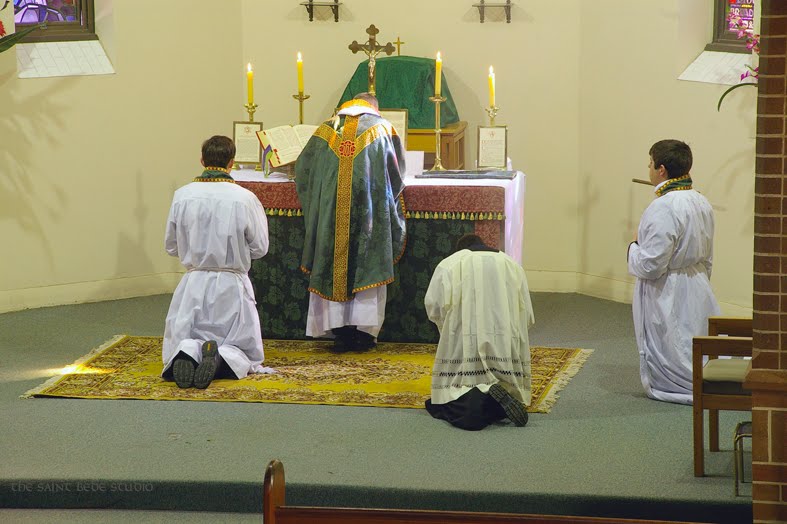
This post features a chasuble and cope set, with matching antependium, which the Saint Bede Studio has made for the use of the Latin Mass Community in Newcastle (Australia). These vestments have already been used for a Missa Cantata at Saint Patrick's church Wallsend, which has been featured on The New Liturgical Movement and The Hermeneutic of Continuity.Some photographs are included from the Mass, in addition to a studio image of the cope. A forest green damask was used for these vestments, ornamented with Puginesque braids in red and gold.
Enquiries: stbede62@gmail.com
Click on the images for an enlarged view.

Subscribe to:
Posts (Atom)