
Friday, 26 October 2012
2013 Ordinands
A short notice for those who will be ordained to the Sacred Priesthood in 2013. If you are considering having vestments made by the Studio, please contact us without delay to begin discussions.

Monday, 22 October 2012
The Papal Fanon

Read a little more about the significance of the Fanon - a vestment unique to the Roman Pontiff - here.
It was also pleasing, after recent infelicitous ensembles, to see the Pope wearing a rather tasteful chasuble and mitre of white damask derived from the Italian style of the 14th and 15th centuries (before Papal Rome was Baroque).
These images on this post are taken from the website of the Italian photographer Spaziani.
Click on the images for an enlarged view.


Thursday, 27 September 2012

Tuesday, 25 September 2012
A Moveable Feast
 | |||||
| Apse of the Karaganda Cathedral. |
Recently, we have seen on some Blogs a coverage of the construction and consecration of the Cathedral Church of the Diocese of Karaganda, Saint Joseph's. What appears to be an historic altarpiece has been installed as the High altar and focal point of the Cathedral. It is an extremely impressive ensemble visually, constructed of timber, polychromed and gilded.
 |
| The two altars sit in harmonious proximity to each other and appear almost as one unit. |
Standing in front of the High altar is another altar,freestanding, which has been the subject of some discussion in the Comboxes. A timber altar, with rather beautifully done carving, is the altar at which Mass is intended to be celebrated. But it is not fixed: it sits on a splendid carpet at the same level as the High altar, and the whole thing could readily be moved out of the way. But this altar was consecrated and a rather ingenious method of construction was then revealed. Approximately two-thirds of the mensa was a slab of marble, incised with consecration crosses and set into the timber table of the altar. This stone itself was consecrated by the Dean of the Sacred College, Cardinal Sodano during Mass on 8th September. Beneath the mensa was placed a small house containing the sacred relics.
 |
| The large marble stone set into the mensa of the freestanding altar. |
 |
| Detail of the High altar shewing the patina of the old paintwork. |
Click on the images for an enlarged view.
 |
| A relic house about to be placed beneath the freestanding altar. |
Sunday, 16 September 2012
Saint Camillus de Lellis

A kindly priest customer of the Studio sent us this rare portrait of Saint Camillus de Lellis (1550-1614), co-Patron Saint of Nurses. Saint Camillus spent most of his life caring for the sick. Read more about him here.
Saint Camillus was ordained a priest in 1584 by the last Catholic English bishop, Lord Thomas Goldwell.
The adjacent image of Saint Camillus is said to be only contemporaneous portrait of him and shews him during the Offertory of the Mass. The Saint is wearing a style of chasuble common in the sixteenth century and often associated with Saint Philip Neri. Saint Philip was a spiritual mentor of Saint Camillus.
The chasuble is made from an ivory-coloured silk brocade interwoven with gold, but perhaps its most interest feature is its orphrey ornamentation. The orphrey appears to be formed from a woven braid in colours of black and gold on an off-white base. Most interesting is the design of this braid, being a series of interlinked geometric motifs: quite unlike the style of ornament found on other chasubles of this period and in the two centuries following.
Wednesday, 12 September 2012
Puginesque vestments
 The Saint Bede Studio recently completed sets of vestments for a priest of the Archdiocese of Sydney. The vestments were made in the more stylised cut of the 16th century, which is sometimes referred to as Gothic Revival.
 Each of these vestments was made from an English ecclesiastical brocade and ornamented with a different orphrey braid based on the work of AWN Pugin. The three vestments - in crimson red, ivory and green are shewn in the adjacent photographs.
An apparelled amice is employed with each of these vestments.
Click on the images for an enlarged view.
Enquiries: stbede62@gmail.com


Monday, 10 September 2012
Simple Cope
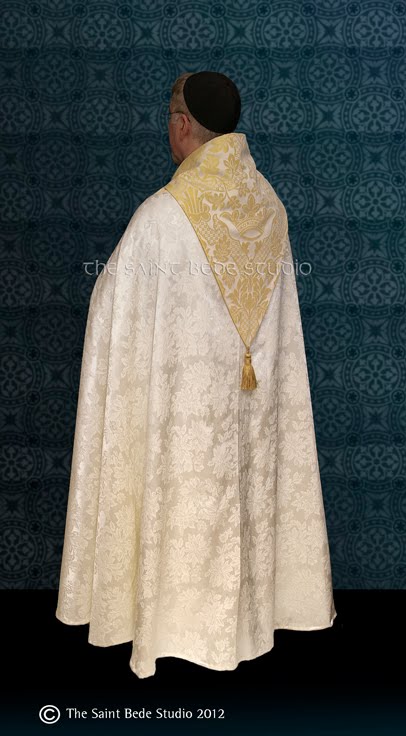
Above is pictured a cope recently produced by the Studio. It is a simple vestment, made from a cotton jacquard and ornamented with an English ecclesiastical brocade in colours of ivory and straw. The cope is unlined.
Enquiries: stbede62@gmail.com
Saturday, 8 September 2012
Belloc
 |
| Hilaire Belloc with GB Shaw (left) and GK Chesterton. |
Wherever the Catholic sun doth shine,
There’s always laughter and good red wine.
At least, I’ve always found it so;
Benedicamus Domino.
Hilaire Belloc (1870 - 1953).
Tuesday, 4 September 2012
Roman vestments of the 16th century

The chasuble is made from an ivory English ecclesiastical brocade, ornamented in the Roman manner with a damask of silk and cotton in burgundy and old gold, and outlined with a galloon. The chasuble is lined in crimson red.
Click on the image for an enlarged view.
Enquiries: stbede62@gmail.com
Saturday, 1 September 2012
Newsletter

Today, the September Newsletter was sent to all customers and past enquirers of the Studio. If you are a reader of this Blog and would like to receive a copy of the Newsletter, please contact us.
Subscribe to:
Posts (Atom)