 |
| An ample red chasuble in the Saint Martin style made by the Studio and ornamented with the TAU. |

Tuesday, 30 April 2013
The TAU : Symbol of our Redemption

Saturday, 27 April 2013
Mass in the Pauline Chapel
 On the Feast of Saint George, 23rd April, Pope Francis celebrated Mass in the Pauline Chapel (adjacent to the Sistine Chapel).The former Cardinal Bergoglio's Christian name was Jorge, and he wished to celebrate his patron saint's Feastday with Cardinals resident or visiting Rome and members of the Papal Household. Afterwards in a courtyard, the band of the Swiss Guards performed in the presence of the Pope and the Cardinals.
The candlesticks and crucifix on the altar were disposed in the so-called Benedictine arrangement, whilst the Papal throne stood on the Gospel side of the altar. The Pauline Chapel had been restored during the Pontificate of Pope Benedict and its altar has been arranged to allow Mass to be offered versus populum or ad orientem.
These photographs are the copyright of L'Osservatore Romano. An identification number appears below each image, so that a copy might be ordered from L'Osservatore, if desired.
 |
| Pope Francis entering the Pauline Chapel. |
 |
| Address of the Cardinal-Dean. Note the restored freestanding altar. |
 |
| Blessing of the Deacon before the Gospel. |
 |
| Incensing the oblations. |
 |
| The Pope is honoured with incense. |
 |
| During the Canon. Note the tabernacle behind the altar in the form of a classical portico. |
 |
| During the Canon. |
 |
| After Mass, Pope Francis prayed before and venerated the Icon of the Blessed Virgin. |
Friday, 26 April 2013
The TAU: Symbol of Christ
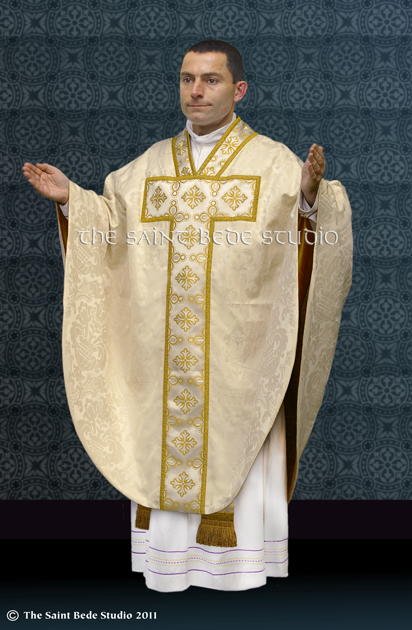 |
| An ample chasuble made by the Saint Bede Studio. The decorative scheme is simple and features the TAU: symbol of Christ. |
Tuesday, 23 April 2013
The Tau and Christian vestments : 1
 |
| A late 13th century statue of Pope Boniface VIII shewing the TAU ornament on his chasuble. The tiara worn by Boniface was likely exaggerated in proportion by the sculptor, but is it not lofty? |
These two original purposes for braids were intended for the convenient use of the vestment, not as ornamental, still less symbolic.
As such matters develop, however, these utilitarian braids became highly-ornamental, even embroidered with symbols and figures of the saints etc. It was Pope Innocent III (1198-1216) who, in his treatise De Sacro Altaris Mysterio first described the liturgical vestments in terms of their symbolism. He it was who also emphasised the TAU as a Christian symbol and from that time, especially through the spread of the Franciscan way, did the TAU become known throughout the Western Church.
Thus it was that the braids which were once used on the chasuble merely for utility, developed into a Christological symbol.
These articles are intended to illustrate the continuity of the use of the TAU as a means of ornamenting chasubles in Rome after the time of Innocent III: not quite one millenium.
We wish to start with a digression by discussing in this post the famous statue of Saint Philip Neri in the sacristy of the church of Santa Maria in Vallicella, Rome. This marvellous 3-metre tall statue was completed in 1638 by the famed Italian sculptor Alessandro Algardi.
Attached is a digitally-enhanced photograph of the statue. It is emphasised that this enhancement is NOT intended to depict actual colours or decoration. It is intended to show more clearly the form and decoration of the chasuble that Algardi sculpted.
 This is a chasuble in the Roman tradition. It is very long at the back, reaching almost the full length of the alb; at the front it is slightly shorter. It has a curved shape, rather than being squared-off at the bottom. Note that the chasuble falls gracefully over the body, indicating that it is not interlined to stiffen it, as chasubles were of the later Baroque period. It largely corresponds to dimensions set down by Saint Charles Borromeo (whilst Archbishop of Milan 1560-1584), but it is slightly narrower, since as sculpted it falls only slightly beyond the elbow, rather than approaching the wrist.
Very prominent on the chasuble is the oversized TAU, with adjoining panels supporting the neckline. Almost certainly, the rear of the chasuble would have been ornamented with a single column. These ornaments are formed from a floral scrollwork damask, outlined with a galloon (probably 3cm wide).
In terms of studying the history of the development of the chasuble, this statue is most significant. It is important to note that the statue was sculpted within the living memory of Saint Philip (he died in 1595). And yet, it reflects a style of chasuble found in the first quarter of the 17th century.
Next post: The Tau, Pope Innocent III and Saint Francis.
Sunday, 21 April 2013
Ordinations in the Vatican Basilica
.jpg)
Commemorating World Vocations Day, Pope Francis today ordained ten men to the Sacred Priesthood in Saint Peter's Basilica.
On this occasion, Pope Francis wore a new mitre, similar in appearance to those mitres he has worn since his election. Made of cream-coloured silk, it is simply, but tastefully ornamented. The Pope and his deacons-assistant wore white vestments which were made for the use of the Blessed John Paul II, employing an unusual ornamental scheme in blue and gold, derived from symbols and decorative motifs of early Christian Rome.
The following photographs are from the Archive of Getty Images and Alessandro Benedetti.


Saturday, 20 April 2013
Chasubles Styles of the Roman Rite : 2 Republished
PART TWO: THE SEMI-CONICAL CHASUBLE
 |
| Semi-conical chasuble made by the Studio for the Church of S' Birinus in Oxfordshire, UK. |
 |
| Semi-conical chasuble of S' Bernard kept at the Aachen Cathedral. |
The modification of the shape of the chasuble which was handed on from the earliest centuries of the Church, and which was discussed in our previous article, seems to have been initiated solely for convenience to the wearer: the enveloping conical form greatly restricted arm movement. Although many authors specify the Thirteenth century as the period for the modification to the form, we find surviving chasubles from the Twelfth century in the semi-conical form.
In the Thirteenth century, three further significant reasons brought about a desire to reduce the dimensions of the chasuble. The first was the introduction of the Elevations during the Canon of the Mass. The second was the rise of the private Mass, in other words, a Mass where the celebrant would not be assisted by a deacon and subdeacon (who were to lift and hold back the chasuble at certain points in the Mass to free the arms of the celebrant). Consequently, the celebrant had the need for a greater freedom of movement for his arms and the chasuble was redesigned in order to accommodate that. Additionally, the types of fabrics used for vestments changed from the Thirteenth century, and were heavier (often embroidered) and stiffer than the silks and wools used in previous centuries. In short, there were practical reasons to modify the dimensions of the chasuble.
 |
| Semi-conical chasuble of S' Thomas Becket at the Sens Cathedral Photograph reproduced under licence from Kornbluth Photography. |
 |
| Detail of a 15th century painting depicting S' Augustine wearing a semi-conical chasuble. |
How was the chasuble form modified?
Modification happened in stages and not uniformly across the Church in the West. In the first instance, the semi-circular shape of the chasuble was cut back in such a way that the bulk of fabric to be supported on the arms was reduced. The chasubles depicted above, said to have been worn by Saint Bernard (1090-1153) and Saint Thomas Becket (1118-1170) are examples of this earliest modification. Notice that what had been a bell-shaped garment has become pointed. According to some scholars, the introduction of shoulder seams allowed the width of the chasuble form progressively to be reduced from the traditional conical form, but this will be discussed in the third article in this series.
The photograph of S' Thomas Becket's chasuble was made available by Dr Genevra Kornbluth. It may not be reproduced. Other images of the Becket vestments may be seen at the same site.
The photograph of S' Thomas Becket's chasuble was made available by Dr Genevra Kornbluth. It may not be reproduced. Other images of the Becket vestments may be seen at the same site.
 |
| The back and front of a semi-conical chasuble made by the Saint Bede Studio. |
Click on the images for an enlarged view.
Enquiries: stbede62@gmail.com
Wednesday, 17 April 2013
Liturgical Aesthetics of Pope Francis : 3
 |
| Cardinal Bergoglio. |
And for the Mass which Inaugurated his Petrine Ministry, lo! what did we see? New vestments had been made for Pope Francis and his deacons-assistant which matched the mitre he already owned. The chasuble and dalmatics were full and free-flowing, unlined, made from plain fabrics and ornamented with great simplicity. A great blessing was the absence of those roll-over collars which are often very unfortunate.
 |
| Pope Francis at the Good Friday Solemn Papal Liturgy. |
The ornament on these two chasubles, red and white, is exactly the same, consisting of a column back and front, but an unusual decoration of the neckline, which is angular. This ornament is not an innovation, but is indeed very ancient, as can be seen from the adjacent image.
 |
| Two bishops in attendance at the Enthronement of the Emperor Otto III: an illumination of the late 10th century. |
Does such an ornament have any particular significance or symbolism? No. Its purpose is purely to strengthen the opening in the chasuble which sits around the neck. It will be noticed that the ornament in the the chasubles worn by the two Ottonian bishops is perfectly plain. This is of the period when vestments were not always embroidered and otherwise decorated and the ornaments themselves were merely for utility not symbolic. The chasubles depicted are, of course, not in the same style as our modern chasubles, but rather in the conical form: a shape of chasuble which had been worn from the earliest days of the Church.
As an aside, we can see quite clearly that each bishop is vested in albe, stole, pontifical dalmatic and chasuble, over the top of which is worn a beautifully long pallium. But something else is evident: these bishops are not wearing mitres. This illumination predates that period when the mitre was universally worn by bishops.
So, the new Papal vestments have an ancient precedent in their decoration. The General Instruction on the 2007 Missale Romanum says this about sacred vestments:
343. In additional to the traditional materials, natural fabrics proper to the region may be used for making sacred vestments: artificial fabrics that are in keeping with the dignity of the sacred action and the person wearing them may also be used. The Conference of Bishops will be the judge in this matter.
344. It is fitting that the beauty and nobility of each vestment derive not from abundance of overly-lavish ornamentation but rather from the material that is used and from the design. Ornamentation on vestments should, moreover, consist only of figures, that is, of images or symbols, which evoke sacred use, avoiding thereby anything unbecoming.
Do the new Papal vestments conform with these directives? Broadly speaking yes, but perhaps more might be said. We are not discussing vestments for a simple priest, for Parish use, or even of a bishop, but of the Pope. There is nothing inappropriate about Pope Francis wishing to embrace an aesthetic for Papal vestments which is simple, not ornate. Two points might be made, however, respectfully.
Would it be more fitting if the vestments made for use of the Pope were made from traditional materials (as the Instruction puts it), namely silk or even wool: natural fabrics? These have always been esteemed by the Church.
Although there is nothing unworthy about the decorative scheme of the new Papal vestments, is it not odd that the vestments of the Vicar of Christ lack any form of Christological symbolism? Alternatively, this symbolism can also be expressed in the manner of the orphrey, most particularly the TAU orphrey and the Y-shaped orphrey, both of which represent the Cross.
Lastly, we might hope that these new vestments do not have a long life and when they have become unfit for use, Pope Francis takes advantage of the many, many vestments stored in the Papal Sacristy which belonged to his predecessors Paul VI and John Paul II, which do conform to the two principles mentioned in the General Instructions.
Next post: The "TAU" and continuity in the decoration of the chasuble in Rome.
 |
| The Blessed John Paul II wearing a chasuble of no particular beauty but with prominent Christological symbolism. |
 |
| The Enthronement of Otto III (tenth century). |
Saturday, 13 April 2013
Tiara of Pope Honorius III
 |
| Pope Honorius III. |
One of the frescoes, a detail of which is shewn above is a scene where Saint Francis is preaching a homily in the presence of Pope Honorius III (reigned 1216-1227). This has recently caught our eye, during research into the Papal tiara, which was the subject of a previous post.
Below is the much-disliked triple tiara of Pope Paul VI, made of platinum and gold and presented to Paul by the Faithful of his former archdiocese, Milan, in 1963. It is certain that Pope Paul oversaw the design of his triple tiara, but until now the striking similarity between it and the tiara of Pope Honorius III has not been discussed, so far as we are aware. Whilst the Paul VI tiara is entirely metallic, that of Honorius would have been made from silk or velvet, which was embroidered and over which a single crown was placed. Next time someone denounces the "bullet tiara" or the "space age tiara" of Pope Paul, you can refer them to these images.
 |
| Triple tiara of Pope Paul VI : intended as a replica of the Giotto tiara? |
Not much of the albe is visible, except its close-fitting sleeves. The amice is voluminous and worn in the style of a thrown-back hood. The pontifical dalmatic is made from an especially rich brocaded silk, its woven pattern being reminiscent of Cosmati tile work or forms of ornament pre-dating the Gothic style; it also has apparels attached to its lower edge and to its cuffs. Interestingly, the artist presents a simpler red chasuble, in the semi-conical form, lined in blue and ornamented subtly with an embroidered orphrey in red and gold.
Most notable is the older and noble form of the pallium, which is highly visible. Contrast this with the mean affair presently used by the Bishop of Rome, a mere shadow of the ancient form. Because of its size, this more ancient form of pallium becomes the principal ornament of the chasuble and a worthy symbol of the Petrine Office. We can hope for its return to Papal Liturgies.
 |
| The fresco in the Upper Church at Assisi. |
Wednesday, 10 April 2013
The Papal Staff of Pope Paul VI
 |
| At the Lateran Basilica |
The return of this ferula, which had ceased to be used by Pope Benedict in 2008, has occasioned a reaction on some websites. We have no idea whether Pope Francis intends to use this staff regularly, occasionally or usually. We should just wait and see.
The Blessed John Paul II made exclusive use of the Scorzelli staff, but in 1990, Scorzelli made a copy of it to present to John Paul, which the Pope used from that time onward.
Surprisingly, however, Pope Paul did not use that particular Scorzelli staff exclusively. He also made use of three others, which are shewn in photographs at a previous post in our Papal Retrospective: here. We cannot say whether these three other staffs were also designed by Lello Scorzelli.
Monday, 8 April 2013
The Lateran Basilica
 |
| The Pope is handed his Pastoral Staff as Bishop of Rome. |
Pope Francis chose to use the Pastoral Staff of his predecessors Paul VI and the Blessed John Paul II.
These photographs are the copyright of Getty Images and Alessandra Benedetti.
 |
| At the Cathedra of S' John Lateran. No celebrant other than the Pope may sit at this throne. |
 |
| The Papal Staff of Pope Paul VI. |
 |
| Blessing with the Evangelarium |
 |
| During the Preface. |
 |
| At the Doxology. |
Subscribe to:
Posts (Atom)