Saturday, 30 November 2013

The Colours of Advent

Often it is asserted by liturgical commentators and other internet experts, that there are "correct" colours for the vestments used during Lent and Advent. Curious as to the history of these colours in Liturgical use, some years ago we researched and posted an article  here and here, about use of penitential colours for the Seasons of Advent and Lent. If you have wondered what colour the Church recommends for these Seasons, you might find the article illuminating.  

We include here an historic work of art to illustrate the practice of our forebears. This work (adjacent) was painted by an artist known as The Master of Osservanza in the year 1440 and depicts a Low Mass being offered at a side chapel in the Siena Cathedral (Italy).

Some observations. The chasuble being worn by the celebrant is violet: in other words, much the same colour as the flower "violets". It is a blue-ish colour, not purple and it is not too dark either. The chasuble is the full conical shape and is ornamented with a simple column-orphrey of dark fabric (possibly even black). Most likely, the front of the chasuble would have been decorated with the familiar "tau". The celebrant is wearing decorative apparels on his alb and amice, which match the colour of the chasuble's ornament. That is a very typical practice of the Mediaeval period. Note, too, the very full folds of the alb.

We see, also, that the boy assisting the celebrant is wearing a full-length surplice, according to the style typically found in Renaissance Italy. Those who claim that such surplices are "Church of England" garment should note this well.

Lastly, the altar itself. It is clothed in a dark antependium or altar frontal, ornamented with scarlet red. On the altar is a Crucifix and a single candle. Although it may seem peculiar that there is but a single candle instead of a pair, it might be remarked that not until the 16th century was it a usual practice to have a pair of candlesticks on an altar.

Click on the image for an enlarged view.

Tuesday, 26 November 2013

Concluding the Time "Per Annum"

At the conclusion of the 2013 Liturgical Year, we are pleased to present this pleasing set of green vestments.

A priest of the Archdiocese of Dublin, a returning customer, commissioned the Studio to make a set of vestments in a subdued shade of green. After a great deal of searching, a dupion silk in a rich shade of olive green was chosen for the vestments.

The chasuble, in the Saint Philip Neri style, is ornamented with a rich brocade of burgundy and gold according to the Roman form. The vestments are lined with a wine red taffeta.

Enquiries: stbede62@gmail.com

Click on the images for an enlarged view.


Wednesday, 13 November 2013

Beuron School of Liturgical Art

Above is a beautiful liturgical drawing from 1910  in the Beuronese style  Messe mit Wandlungskerze auf dem Altar. It was found at the Wikimedia Commons. Go here to read a little about the Beuron School of liturgical art.

This stylised depiction of a priest celebrating Low Mass is rich with the aesthetic ideals of the Liturgical Movement. The celebrant wears a flowing albe, ornamented with continuous decoration around its hem. Over this he is vested in a conical chasuble, decorated very simply. Not least of interest is the manner in which the altar cloth is decorated, with geometric embroideries and tassles of silk. 

One curiosity is the almost sleeveless surplice being worn by the altar server. Note the restrained gesture with which he lifts the celebrant's chasuble for the Elevation.

Would that this dignified aesthetic were more fully adopted for the celebration of Mass according to both usages of the Roman Rite.

Saturday, 9 November 2013

South Korea : 2


The Saint Bede Studio has completed a commission for two sets of vestments for a Latin Mass Community in South Korea. This is the Studio's first work in Asia. The first set was featured in a recent post; the second set is shewn in the adjacent photographs.

This is a Low Mass set in the Borromeon style of the 16th century. The vestments were made from an ecclesiastical brocade in muted gold and ornamented with an Italian damask in colours of wine red and gold. A floral galloon outlines the ornament.

Enquiries: stbede62@gmail.com

Click on the images for an enlarged view.


Wednesday, 6 November 2013

Papal Mass in Saint Peter's 1965

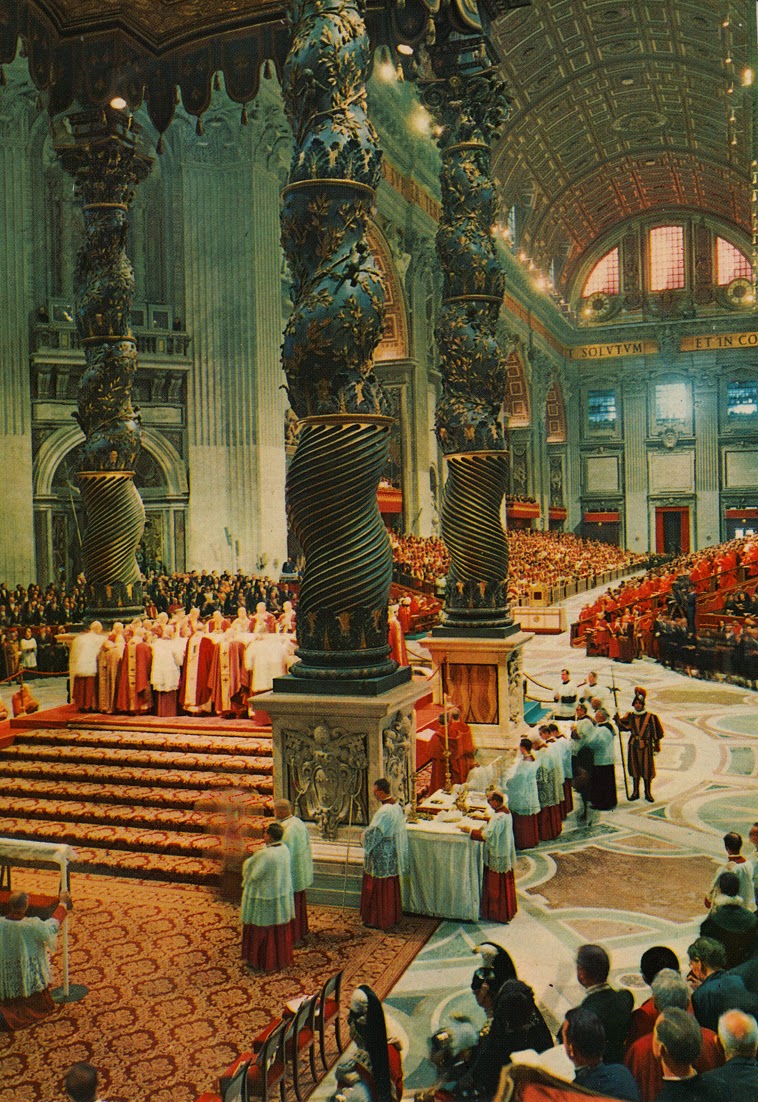
Adjacent is a rather rare photograph, taken in Saint Peter's during a Session of the Second Vatican Council.

Standing at the centre of the altar is Pope Paul VI and with him, concelebrating bishops. At the Opening of the Third and Fourth Sessions of the Council, which took place on 14th September, 1964 and 14th September, 1965 respectively, Pope Paul concelebrated Mass in the basilica with a select number of the Council Fathers.

This Mass, of course, is being celebrated according to those modifications of the Extraordinary Form of the Roman Rite known colloquially as The Interim Missal. The Rite of concelebration, however, is quite similar to that which is found in the new Missal of 1969.

Nevertheless, the concelebrated Masses celebrated in Saint Peter's before the introduction of the new Missal differed very significantly from those after that date, as is illustrated by this photograph. Although the Basilica on this occasion in 1964 or 1965 was filled with bishops, archbishops and cardinals from all around the world, only a small number concelebrated with the Pope.

These concelebrants were standing at the altar during the Canon and Communion Rite. To facilitate this, a temporary enlargement of the altar of the Confession was made, together with platforms on which the concelebrants would stand.

It was of little importance that the concelebrants obscured the congregation's view of the principal celebrant, the Pope. The most important considerations, therefore, were that the concelebrants stood at the altar in close proximity to each other (and the principal celebrant) AND that they could clearly look upon the elements to be consecrated.

Click on the images for an enlarged view.


Sunday, 3 November 2013

Papal Ferula

On the Solemnity of All the Saints, Pope celebrated Mass at the gateway of the Campo Verano Cemetery in Rome.  On this occasion, the Pope used a new ferula, or staff.

It seems the staff was donated by the Italian Goldlake Mining Corporation and that metals for the staff came from Argentina and Honduras.

The staff is purported to depict the Resurrected Christ.


Thursday, 31 October 2013

South Korea : 1

The Saint Bede Studio has completed a commission for two sets of vestments for a Latin Mass Community in South Korea. This is the Studio's first work in Asia. The first set is shewn in the adjacent photographs.

This is a Low Mass set in the Saint Philip Neri style of the 16th century. The vestments were made from an English ecclesiastical brocade and ornamented with an Italian damask in colours of wine red and gold. A floral galloon outlines the ornament.

Enquiries: stbede62@gmail.com


Click on the images for an enlarged view.


Monday, 21 October 2013

Tilting at Windmills

"Tilting at Windmills", a phrase that has come to mean attacking imaginary enemies.

This expression is explained at The Phrase Finder:

Tilting is jousting. "Tilting at windmills" derives from Cervantes' Don Quixote - first published in 1604, under the title The Ingenious Knight of La Mancha. The novel recounts the exploits of would-be knight Don Quixote and his loyal servant Sancho Panza who propose to fight injustice through chivalry. It is considered one of the major literary masterpieces and remains a best seller in numerous translations. In the book, which also gives us the adjective quixotic (striving for visionary ideals), the eponymous hero imagines himself to be fighting giants when he attacks windmills.

Just then they came in sight of thirty or forty windmills that rise from that plain. And no sooner did Don Quixote see them that he said to his squire, "Fortune is guiding our affairs better than we ourselves could have wished. Do you see over yonder, friend Sancho, thirty or forty hulking giants? I intend to do battle with them and slay them. With their spoils we shall begin to be rich for this is a righteous war and the removal of so foul a brood from off the face of the earth is a service God will bless."

"What giants?" asked Sancho Panza.

"Those you see over there," replied his master, "with their long arms. Some of them have arms well nigh two leagues in length."

"Take care, sir," cried Sancho. "Those over there are not giants but windmills. Those things that seem to be their arms are sails which, when they are whirled around by the wind, turn the millstone."


The figurative reference to tilting at windmills came a little later. John Cleveland published The character of a London Diurnall in 1644 (a diurnall was, as you might expect, part-way between a diary or journal):

"The Quixotes of this Age fight with the Wind-mills of their owne Heads."

The full form of the phrase isn't used until towards the end of the 19th century.


Saint Stephen Protomartyr
Fifteenth Century


The above painting, dating from around the year 1450, is a reproduction of the left-panel in a diptych, painted by the French Renaissance artist Jean Fouquet and formerly in the Church in Melun (near Paris). It depicts Saint Stephen with the French diplomat Etienne Chevalier.

Saint Stephen is depicted wearing an ample dalmatic made from what appears to be black velvet (but it may be black wool).  It is ornamented with clavi formed from strips of a silk damask of a familiar Renaissance pattern. The dalmatic is extremely simple.

The more ancient form of the amice is also shewn, being very ample and not fitting closely around the neck. To this amice, an apparel is attached made from the same silk damask as the dalmatic's ornament. It was usual in the mediaeval period and beyond for an amice apparel to match the ornament of the vestments. Usual, too, was that the stole and maniple also matched the ornamentation of the vestments, rather than matching the base colour (namely, the liturgical colour of the vestments).

We find the following information at the Web Gallery of Art.

This is the left wing of a diptych, originally located in Melun. The diptych was in the chancel of the Church of Notre-Dame at Melun, south of Paris, from 1461 until about 1775, when the two halves became separated.

Etienne Chevalier, who came from Melun, was French Ambassador to England in 1445 and six years later became Treasurer to Charles VII of France. He presented the diptych (of which this panel forms the left wing), to his native town around 1450; on this wing he had himself painted next to his patron saint, Stephen. The saint is holding a book, on which a jagged stone is lying, as a symbol of his martyrdom. The formal architecture in the background is in the Italian Renaissance style showing pilasters with coloured inlaid marble panels between them. On the wall, receding in perspective, the name Etienne Chevalier is inscribed several times. Originally the donor and the saint were looking towards the Madonna, who occupied the right wing of the diptych; this panel found its way into the Antwerp Museum.


According to a description of the paintings by Denis Godefroy in 1661, the original frames were covered in blue velvet. Round each picture were strands of gold and silver thread, in which the donor's initials were woven in pearls. There were also gilded medallions on which stories of the saints were represented.


Collegiate Church of Notre-Dame de Melun, founded in 1013.

Thursday, 17 October 2013

Puginesque Vestments
for the Season "Per Annum"

Pictured adjacent is the Saint Giles chasuble, a familar style to readers of this Blog. It is a simplified version of a design by A.W.N. Pugin.  A green brocade (Emerald green on a very dark base colour) is ornamented with a Puginesque braids in red and gold and lined in scarlet-red. The braids were produced exclusively for the Saint Bede Studio.

This chasuble was commissioned by a priest of the Archdiocese of Sydney.

Enquiries: stbede62@gmail.com

Click on the image for an enlarged view.