Thursday, 24 February 2022

To What End Sacred Vestments?

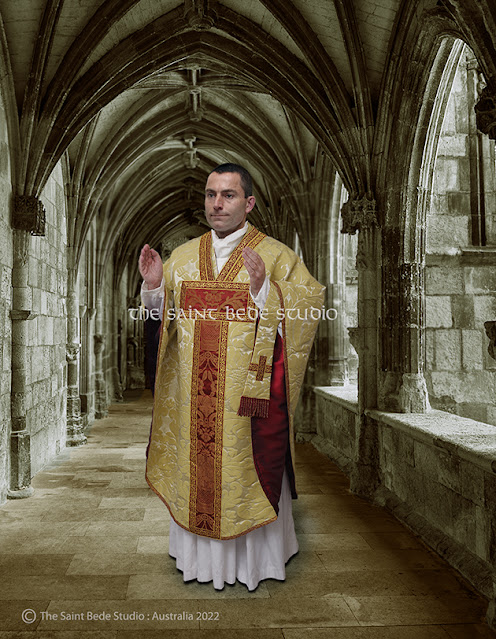
Solemn Mass at the Abbey of 
Saint Madeleine, Le Barroux.
If we were to accept the notion that a priest is the "president of the christian assembly" then what he wears to celebrate the Sacred Liturgy would be merely an expression of his personality or tastes. The notion of presider is an entirely modern (and an execrable) concept. A priest, bishop or Pope celebrates the Sacred Mysteries. In the East, the term used is to serve.

Because the celebrant is least of all a "presider", what he wears should not essentially be about his own preferences and personality. A priest should ask of himself :

Is what I am wearing worthy of my ministry standing between God and man to offer the Holy Sacrifice?

Will what I am wearing draw those who look upon me during Mass into a closer appreciation of the Sacred Mysteries, in other words, will it raise their hearts and minds to God?

Or will it act as a distraction to the Faithful attending Mass?

Wednesday, 9 February 2022

The Ethos of the More Ancient Use of the Roman Rite

In 1970, when the New Order of Mass was introduced, much was changed pertaining to the celebration of Mass and everything associated with it. The nature of the Mass, of course, did not change, but how it was presented changed very markedly. It was far more than a change from Latin to English: it involved a change in emphasis. In trying to simplify the Sacred Liturgy and make it more readily comprehensible, the architects of the New Order of Mass emphasised the communal aspect of the Mass. Typically, the celebrant stands on one side of the altar, facing the congregation, and all are gathered around the table of the Lord, to partake of the Sacred Banquet. Very often there is a strong emphasis on active external participation. 

When the celebrant is not facing the congregation, however, the entire atmosphere of the Mass is changed: both priest and people are facing the same direction to pray. Many have forgotten that from earliest Christian times, Mass was celebrated looking towards the rising sun (a great symbol of the Resurrection, and of Christ’s Second Coming in Glory) : everyone faced this direction. Furthermore, the Mass is not limited to the confines of the building in which it is being celebrated, but is a cosmic event, involving the angels and saints and the souls of the faithful departed who are yet to receive their eternal reward. Simply by changing the position of the celebrant, a different sense of the Mass as a sacred event is conveyed to all present. The great silences, the solemn ritual actions of the celebrant and the beauty of the ancient Latin prayers, all reinforce the mysterious and sacred atmosphere of this More Ancient Use of the Roman Rite. 


The sense of the sacred is not only manifest in the celebration of the Liturgy itself, but in all the things that surround it: the way the celebrant is vested, the manner in which the altar is decorated, the manner in which the celebrant and his ministers conduct themselves in the sanctuary - all of these things are governed by rules which the Church in her wisdom adopted over the course of centuries. 

The vestments, designed for use in the Sacred Liturgy, are required to be blessed. The colour of these vestments varies according to the liturgical season or feast: violet and purple for Advent and Lent; white for Christmas, Easter and Saints’ days; red for Pentecost and for the Apostles and Martyrs; green for the time before Lent and after Pentecost; rose for the mid-point Sundays of Advent and Lent and black for Masses of the dead. 

Just as the celebrant puts on vestments for the Sacred Liturgy, so, too, the chalice and the altar are vested. The altar, which signifies Christ himself and upon which the Sacrifice of the Mass is offered, is vested in a frontal which matches the colour of the celebrant’s vestments. Upon the altar, three cloths made of linen rest. In the middle of the altar a large Cross is placed between the candlesticks. The number of candles is graded according to the solemnity of the occasion, two, four or six. 

The Church has regulated all these things, in order to create a certain image around and to preserve a certain attitude to the Mass. There are other things concerning the More Ancient Use of the Roman Rite about which the Church has made certain regulations; such things are also designed to preserve the sacredness of the Mass and the sanctuary where it is celebrated. At this form of Mass, those receiving Holy Communion must do so on the tongue, not in the hand. Unless there is some disability, those receiving Holy Communion should kneel before the altar at the Communion rail. The same laws of fasting which govern the New Order of Mass also govern the More Ancient Use of the Roman Rite.

An extract from The Order of Mass compiled by the Saint Bede Studio and published in 2008 by the Ignatius Press.

Tuesday, 8 February 2022

Too Many Words

Pope S. Paul VI at the Yankee Stadium NY 1965.
One of the characteristics of the Roman Rite until the introduction of the Missal of Pope Paul VI in 1970, was the balance it achieved between silence, singing, the spoken word and ritual action. Even the so-called Interim Rite, which had various iterations between 1964 and 1968, still preserved much of this balance.  The Roman Rite "spoke" to people on a number of levels, not just the cerebral level. Its silences spoke, its aesthetics spoke, its unique and unworldly music spoke.

On the other hand, one of the great flaws of the Missal of Pope Paul VI is that it is far too cerebral. Everything has to be comprehensible intellectually. The Council Fathers decreed that the Church's Rites had to be "intelligible", but unhappily, the new Missal took this injunction too far.

The typical celebration of the New Mass, Ordinary Form - call it what you will - is very wordy. If the texts in the Missal itself weren't more than enough, we are also subjected to little commentaries, entertainments, even ferverini during the Mass.  There is the Three Sermon Syndrome, where the celebrant speaks at the beginning of the Mass, after the Gospel and then before the Last Blessing. Words, words, words. Too many words.  How can one encounter the transcendent with so many words?

At the same time, ritual action in the New Order of Mass has been reduced to a minimum. Silence is imposed by the celebrant, rather than being organic to the rite. One strange example of this, which we suffer too often, and which has become the touchstone of the more contemporary ars celebrandi, is where the celebrant - having preached his homily - goes and sits down and a period of silence is endured. Presumably we are to meditate on his spoken wisdom: but does anyone remember more than two sentences that he said?  How quintessential such a made-up ritual is to the inward-looking and artificial ethos of the New Order of Mass.

Let us be very careful to avoid an overly-cerebral approach to the Sacred Liturgy (New or Old).  Might we not aim, rather, to recapture and preserve that old balance of the Roman Rite: silence and song supporting the Ritual actions?

Tuesday, 25 January 2022

Priestly Ordinations 2021 : 4

Saint Philip Neri
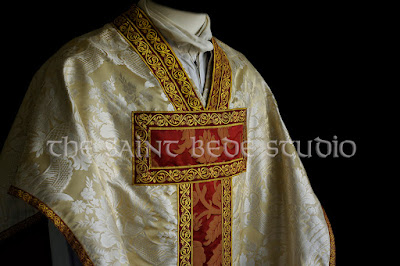
In this post, we are pleased to describe a set of vestments in the Saint Bede Studio's Saint Philip Neri style, which was commissioned by an ordinand from the Philippines.

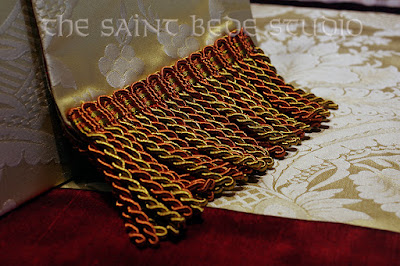
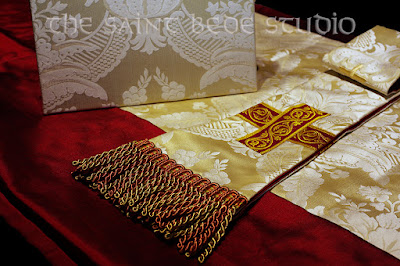
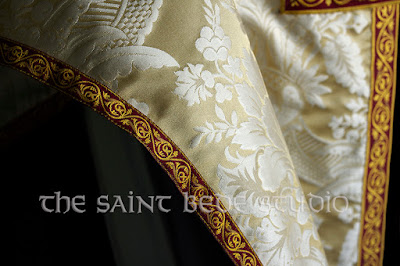
These vestments were made from a lightweight silk
damask in lovely shades of ivory and straw-yellow.  The ornament, in the Roman manner, was formed from a damask in colours deep red and old gold, trimmed with one of the Studio's unique galloons.  The lining of these vestments was formed from a deep red shade of taffeta.

Please pray for all newly-ordained priests.

Click on the images for an enlarged view.

Enquiries : This page. 

Saint Philip Neri


The Saint Bede Studio


The Saint Philip Neri

AMDG

Tuesday, 11 January 2022

Priestly Ordinations 2021 : 3

Borromeon vestments

In this post, we are pleased to describe a set of vestments in the Saint Bede Studio's Borromeon style, which was commissioned by an ordinand from the United States.

These vestments were made from a damask in lovely shades of ivory and straw-yellow.  The ornament, in the Roman manner, was formed from a damask in colours deep red and old gold, trimmed with one of the Studio's unique galloons.  The lining of these vestments was formed from a deep red shade of taffeta.

Please pray for all newly-ordained priests.

Click on the images for an enlarged view.

Enquiries : This page.


The Saint Bede Studio


Borromeon vestments


The Saint Bede Studio


Sunday, 2 January 2022

Greetings to all readers for 2022


This lovely drawing by the English artist Eric Gill depicts an Angel visiting the Child Jesus and his Mother, Mary.  Mary is sitting knitting.  Around the perimeter is written (in Latin) "Let all things praise God, who created (them)."

The ingenious part of this drawing is that by enclosing the figures within a circle, Gill also depicts the planet Earth, with its masses of land and oceans.  The Mother and Child are in the world, yet all things are under their care.  The angels watch over us.

May the Christ-child and his Blessed Mother bring peace and health in mind and body to our troubled world.

The Saint Bede Studio wishes all its customers and readers every Blessing in 2022.

Friday, 24 December 2021

In this Holy Season 2021


To all friends, customers and readers of this Blog, sincere wishes for a Blessed Christmas.

Every valley shall be exalted, and every mountain and hill be made low; the crooked shall be made straight and the rough places, plain; and the Glory of the Lord shall be revealed and all flesh shall see it together, for the mouth of the Lord has spoken it.
Isaiah 40:4-5.

Michael Sternbeck
The Saint Bede Studio
December 2021

Wednesday, 22 December 2021

When the Shepherds Scatter the Sheep : continued

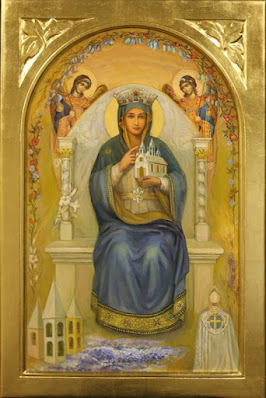
Mother of the Church
For almost five decades I have studied history and the related fields described as "heritage".  Over those many years, I have discovered that not many people are interested in either of these disciplines and - even if they are - it is often quite superficial or nostalgic.  Most people would be familiar with the situation where a building or site of historic importance - even a church - has been treated with disrespect by "developers".  In such moments, we observe an indifference to our heritage.

Something quite different, however, is a focussed contempt for our heritage, as opposed to a mere lack of interest.  What we have observed coming from the Vatican over the last several months is most certainly the former : contempt.

I wish to make a few points in this article, not demanding too much time of readers, since our focus should be on more beautiful moments in this Holy Season.

Within the Church, we do not perceive our heritage in quite the same way as secular society, instead of heritage we use the word Tradition from that definition of the Latin word which means a handing down or a handing on.  Our Catholic Tradition concerns the teachings of the Church, but it also applies to certain externals, such as our ritual worship.

The Church at present seems to be in the grip of an imperative for cultural revision, not unrelated to similar movements in the twentieth century in Russia, China and Germany (to name a few).  Part of the program of those atheistic regimes was the elimination and re-configuring of "heritage" into ideologies to which all persons must be subservient.  It sounds familiar, doesn't it?

After those 20th century tragedies, brought about by aggressive, godless ideologies and the obsessions of hate-filled dictators, and which caused the suffering of millions, who could believe that our Holy Mother the Church would find herself in the twenty-first century in the thrall of another populist leader bent on reconfiguring Her in his own image?  And yet ...

Every Catholic, no matter of what ecclesiological persuasion, age or race, ought to be concerned that the leaders of the Church are attempting to negate our Tradition and cast it as something to be sneered at and loathed.  For this is the message coming from the Vatican with none-too-much subtlety.

The old liturgies of the Roman Rite are not to everyone's taste; they don't encapsulate a form of perfection which can admit of no modification or improvement.  The Fathers of the Second Vatican Council recognised that, and sought to make some changes in the famous document Sacrosanctum Concilium.  But now this same document is used as a weapon by the Vatican in a manner never dreamed of by the Fathers of the Second Vatican Council; whilst at the same time they attempt to convince the Faithful with their smooth words that restriction is exactly what the Fathers of the Council would really want for the sake of unity.

It must be admitted that there are some adherents of the Old Roman Rite who also have extreme views both political and ecclesiastical.  BUT the opponents of the Old Liturgy in Rome - without a great deal of discernment and an outright lack of charity - have used the extreme views of such a minority to persecute those who just wish to attend the form of Mass of their choice.  For those people, their religious heritage and personal sanctification are important.

There is something almost schizophrenic in these Roman regulations.  They are patently vindictive, undiscerning, lacking in charity (from churchmen?).  And they are most certainly motivated by ideology.  Ideology ... yes ... we remember what happened in the past when ideology prevailed.

Let us recognise these deformed acts for what they are and not be fooled that they are based in a charitable desire for unity.

Under God's Providence, may these aberrations be brought to a swift close and a new leader for our Holy Mother emerge whose declared determination is not "to make a mess", but rather to bind up the wounds of Christ's Faithful, a flock scattered by its shepherd.

Mary, Mother of the Church, pray for us.

Michael Sternbeck

22nd December 2021.

Image : Mary Mother of the Church 
https://www.newliturgicalmovement.org/2018/03/the-blessed-virgin-mary-mother-of.html#.YcLWbhNByWY

Sunday, 19 December 2021

When the Shepherds scatter the sheep

O Heavenly Lord

We beseech you continually to inspire the universal Church with the spirit of truth, unity, and concord: And grant, that all who confess your Name may agree in the truth of your Holy Word, and live in unity, and godly love.

We beseech you to give grace to the Bishop of Rome and to all bishops, priests and deacons, that they, by their integrity, piety and right-doctrine, may be faithful witnesses to your true and living Word and rightly and duly administer your holy Sacraments.

We beseech you to guide and prosper those who are labouring for the spread of your Gospel among the nations, and enlighten with your Spirit all places of education and learning; that the whole world may be filled with the knowledge of your truth.

Through Christ our Lord. Amen.

Saturday, 18 December 2021

Rose Vestments in the Gothic Style

Rose vestments
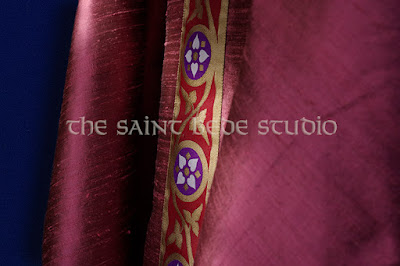
Twice a year, the Church breaks the tone of its penitential seasons by the use of rose-coloured vestments.  Rose-coloured vestments were never commonplace and they still are not.  Many different colours have been deemed by the Church as acceptable as liturgical rose.  Some of these are a salmon shade; some a silvery-pink, almost mushroom-colour; some close to what we would call Bishop's purple or fuchsia; and some red with overtones of gold.

The vestments were made from dupion silk in a quite lovely shade of rose and fully lined in a taup-coloured taffeta.  The vestments were ornamented with a braid from the range of the Studio's unique offerings, called Saint Dunstan.  The braid is in colours of platinum, violet and white upon a crimson background.

Click on the images for an enlarged view.

Enquiries : At this page.


Rose vestments