Saturday, 12 July 2014

Too Many Words

One of the characteristics of the Roman Rite until the Introduction of the Pauline Missal in 1970, was the balance it achieved between silence, singing, the spoken word and ritual action. Even the so-called Interim Rite, which had various iterations between 1964 and 1968, still preserved much of this balance.  The Roman Rite "spoke" to people on a number of levels, not just the cerebral level. Its silences spoke, its aesthetics spoke, its unique and unworldly music spoke.

On the other hand, one of the great flaws of the Pauline Missal is that it is far too cerebral. Everything has to be comprehensible intellectually. The Council Fathers decreed that the Church's Rites had to be "intelligible", but unhappily, the Pauline Missal took this injunction too far.

The typical celebration of the New Mass, Ordinary Form - call it what you will - is very wordy. If the texts in the Missal itself weren't more than enough, we are also subjected to little commentaries, entertainments, even ferverini during the Mass. Words, words, words. Too many words.

At the same time, ritual action in the New Mass has been reduced to a minimum. Silence is imposed by the celebrant, rather than being organic to the Rite. One strange example of this, which we experience too often, is the celebrant - having preached his homily - goes and sits down and a period of silence is endured. Presumably we are to meditate on his spoken wisdom: but does anyone remember more than two sentences that he said?

Let us be very careful to avoid an overly-cerebral approach to the Sacred Liturgy (New or Old).  Might we not aim, rather, to recapture and preserve that old balance of the Roman Rite: silence and song supporting the Ritual actions?

Thursday, 3 July 2014

The Papal Pallium : A Return to Tradition

Pope Francis holding one of the pallia
to be imposed on a new Metropolitan.
It differs very little from the pallium
he himself is wearing.
A welcome return on the Feast of Ss Peter and Paul was the traditional form of the pallium, used by Pope Francis. This form of the pallium, which has been used for centuries by the Popes, was relegated to disuse in unfortunate decisions taken by the Papal Masters of Ceremonies in 2005 and again in 2008.

Those determined to view every act of this Pontificate as a demonstration of the humility of Pope Francis, have heralded this change as further evidence of his simple approach. If anything, it is evidence of his desire to return to that form of pallium worn by his predecessors.

Until 2005, the pallium worn by the Roman Pontiff differed not at all from any other Latin Metropolitan Archbishop. The argument that the Pope should have a pallium distinctive from other bishops was never compelling and is not based in tradition.

We are pleased to post here images of some of Pope Francis' predecessors, wearing pallia in most respects identical with the form commonly seen today.

A study from Jacques-Louis David's famous painting
of the Coronation of Napoleon Buonaparte (1804).
Pope Pius VII is shewn wearing the traditional form of the pallium.

Although the ancient form of the pallium differed considerably from the present, both in its design and form, the insignia in its present form is recognisable from the mediaeval period. It consists of a strip of white wool approximately 6 centimetres wide and joined to form a circle. Attached to this circlet are two pendants, also of wool, approximately 30 centimetres in length and terminating in segment of black wool, rounded at its termination. These pendants hang upon the breast and the back of the wearer. The pallium is adorned with six crosses embroidered in BLACK silk, four crosses on the band and one on each pendant. Into the crosses that rest on the shoulder and in the front pendant are inserted three ornamental pins. These obviously were originally intended to keep the pallium in place, but they have long since been purely ornamental.

Pope Francis during the Mass in S' Peter's Basilica
shewn wearing again the traditional form of the pallium.

Saint Pius X wearing the pallium over the Papal fanon.
During the consecration of bishops in the Sistine Chapel circa 1910.

Pope Pius XI wearing the pallium over the Papal fanon.
The Pope is consecrating Archbishop Schuster of Milan.

Pope Pius XII shewn wearing the pallium.

Saint John XXIII wearing the pallium.

Pope Paul VI shewn wearing the pallium.

Pope John Paul I shewn wearing the pallium.

Saint John Paul II wearing the pallium.

Saturday, 28 June 2014

Priestly Ordinations 2014 : 3


Saint Bede Studio
Each year, the Saint Bede Studio has the privilege of preparing sacred vestments for Ordinands. Happily, this year has been no exception : indeed the number of requests for such vestments has been more than double previous years.

This post concerns Father Samuel Fontana, of the Diocese of Lafayette (Louisiana, USA), who was ordained to the Sacred Priesthood in the Cathedral of the Saint John the Evangelist on 21st June.

Father Fontana commissioned vestments made in the Studio's Saint Martin style for his First Holy Mass. This ample chasuble (shewn adjacent) was made from a beautiful damask in colours of ivory and straw and was ornamented with braids in the colours of burgundy, red and platinum. These braids are unique to the collection of the Saint Bede Studio and are based on the designs of AWN Pugin. The vestments were lined in wine-red taffeta.

Please pray for Father Fontana and for all newly-ordained priests.

Please click on the images for an enlarged view.

Enquiries: stbede62@gmail.com


The Rev'd Samuel Fontana (centre) during his Priestly Ordination.


Interior of the Cathedral of S' John the Evangelist, Lafayette USA.

Saint Bede Studio
Father Fontana's chasuble in the "Saint Martin" style.

Father Fontana pictured after his first Holy Mass
kindly supplied to us by Father Fontana.

Friday, 20 June 2014

Priestly Ordinations 2014 : 2

Each year, the Saint Bede Studio has the privilege of preparing sacred vestments for Ordinands. Happily, this year has been no exception : indeed the number of requests for such vestments has been more than double previous years.

This post concerns Father Jeffrey Paveglio, of the Diocese of Manchester (New Haven, USA), who was ordained to the Sacred Priesthood in the Cathedral of the Saint Joseph on 7th June.

Father Paveglio commissioned vestments made in the Borromeon form for his First Holy Mass. The chasuble (shewn adjacent) was made from a beautiful ecclesiastical brocade in deep red and was ornamented with a brocade in the colours of burgundy, red and gold, outlined with narrow braids, in the Roman style. The vestments were lined in bronze-coloured taffeta.

Please pray for Father Paveglio and for all newly-ordained priests.

Please click on the images for an enlarged view.

Enquiries: stbede62@gmail.com


At the Ordination Mass of Father Paveglio.
Image : Jeff Dachowski Photography


Father Paveglio pictured during his First Holy Mass.

Wednesday, 18 June 2014

Improvements to our Blog

The Saint Bede Studio is pleased to advise some small improvements to our Blog.

In the right hand column (sidebar) is found a series of images depicting our most popular chasuble styles. The images are now "clickable" and each will take the reader to a new page giving a description of the particular style of vestment.

Try it!

Below the images in the sidebar is a list of LABELS. When a post is made on this Blog, a "label" is assigned to it. So, by clicking on a particular label, all the posts which bear that label appear in chronological order in the main column of the Blog: for example, clicking on the BORROMEON label will result in the display of all the posts concerning our vestments in the Borromeon form.

This feature will be particularly helpful to those considering commissioning vestments, but wishing to look at some examples to help inform their choice.

Enquiries: stbede62@gmail.com

Sunday, 15 June 2014

Vestments for Feasts of the Blessed Virgin

The Studio regularly is commissioned to make vestments for use in Masses of the Blessed Virgin Mary. This post concerns our most frequently-made chasuble The Maria Regina.

This chasuble is made in two variants : a more stylised form in the English style, and a more ample "Gothic" form (shewn in the adjacent photograph).

This particular set was made for an Australian priest resident in Rome and is made from an English ecclesiastical brocade and lined in Royal Blue taffeta.

Click on the image for an enlarged view.

Enquiries: stbede62@gmail.com

Monday, 9 June 2014

Priestly Ordinations 2014 : 1

Each year, the Saint Bede Studio has the privilege of preparing sacred vestments for Ordinands. Happily, this year has been no exception : indeed the number of requests for such vestments has been more than double previous years.

This post concerns Father Roberto McCarthy, of the Archdiocese of Hartford (USA), who was ordained to the Sacred Priesthood in the Cathedral of the Saint Joseph on 17th May.

Father McCarthy commissioned vestments made in the Borromeon form for his First Holy Mass. The chasuble (shewn adjacent) was made from a beautiful silk damask in muted gold and was ornamented with a brocade in the colours of burgundy, red and gold, outlined with narrow braids, in the Roman style. The vestments were lined in burgundy taffeta.

Please pray for Father McCarthy and for all newly-ordained priests.

Please click on the images for an enlarged view.

Enquiries: stbede62@gmail.com


The Archbishop of Hartford during the Priestly Ordination.


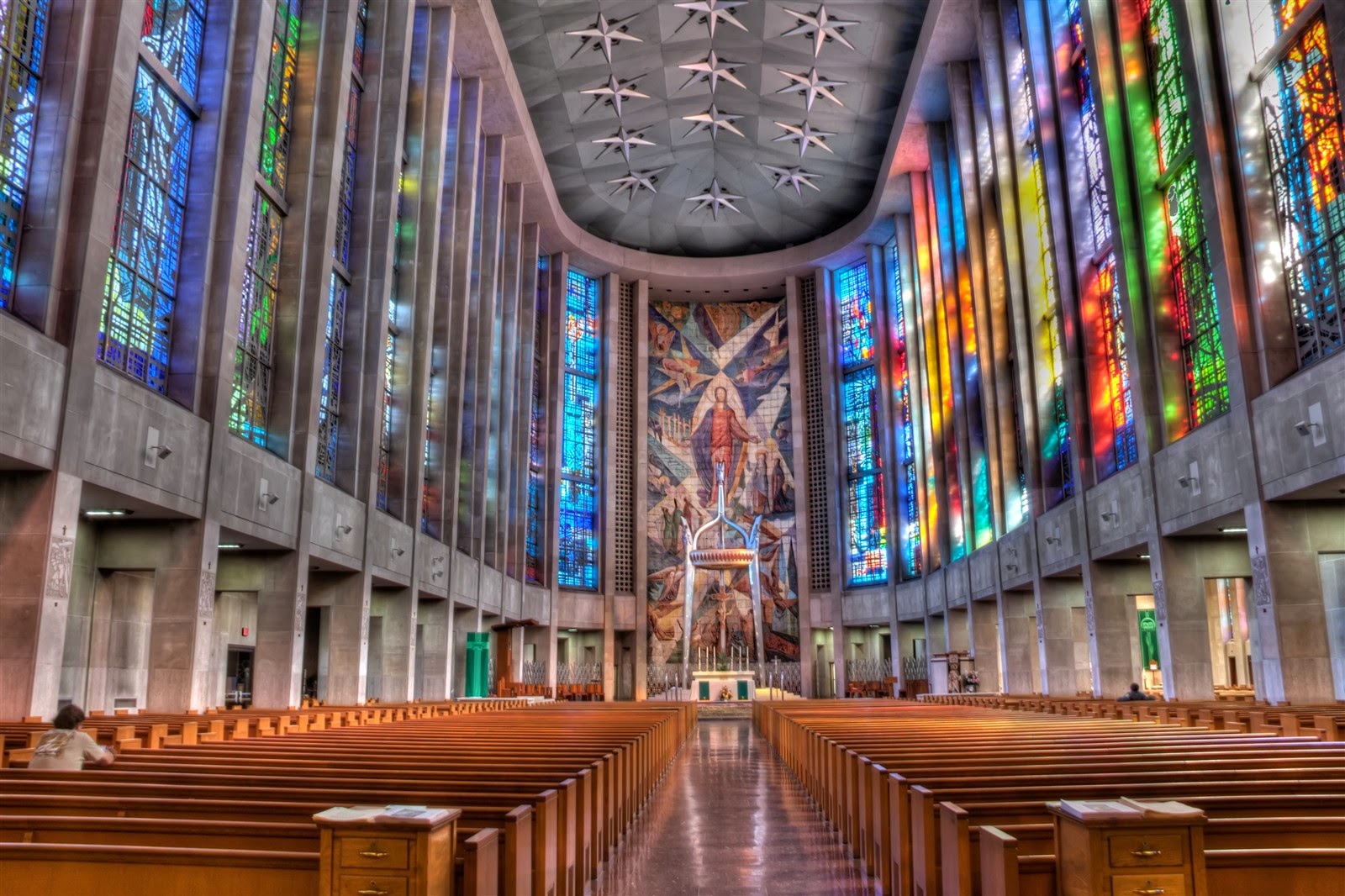
Magnificent interior of the Hartford Cathedral, completed 1962.


This image captures the extraordinary liturgical art
of the chancel of the Hartford Cathedral
including the striking civory over the High altar.

Sunday, 1 June 2014

Ordinands for 2015

This year, the Studio has been blessed with numerous commissions for vestments for ordinands to the Sacred Priesthood. In the coming months, photographs of these vestments will appear on this Blog.

A limited number of places is available for those needing vestments for Ordination in 2015. If you are considering placing a commission with the Studio for Ordination, please do not delay : now is the time to begin your enquiry.

Enquiries: stbede62@gmail.com

Friday, 16 May 2014

Peter Glenville's "Becket" 1964

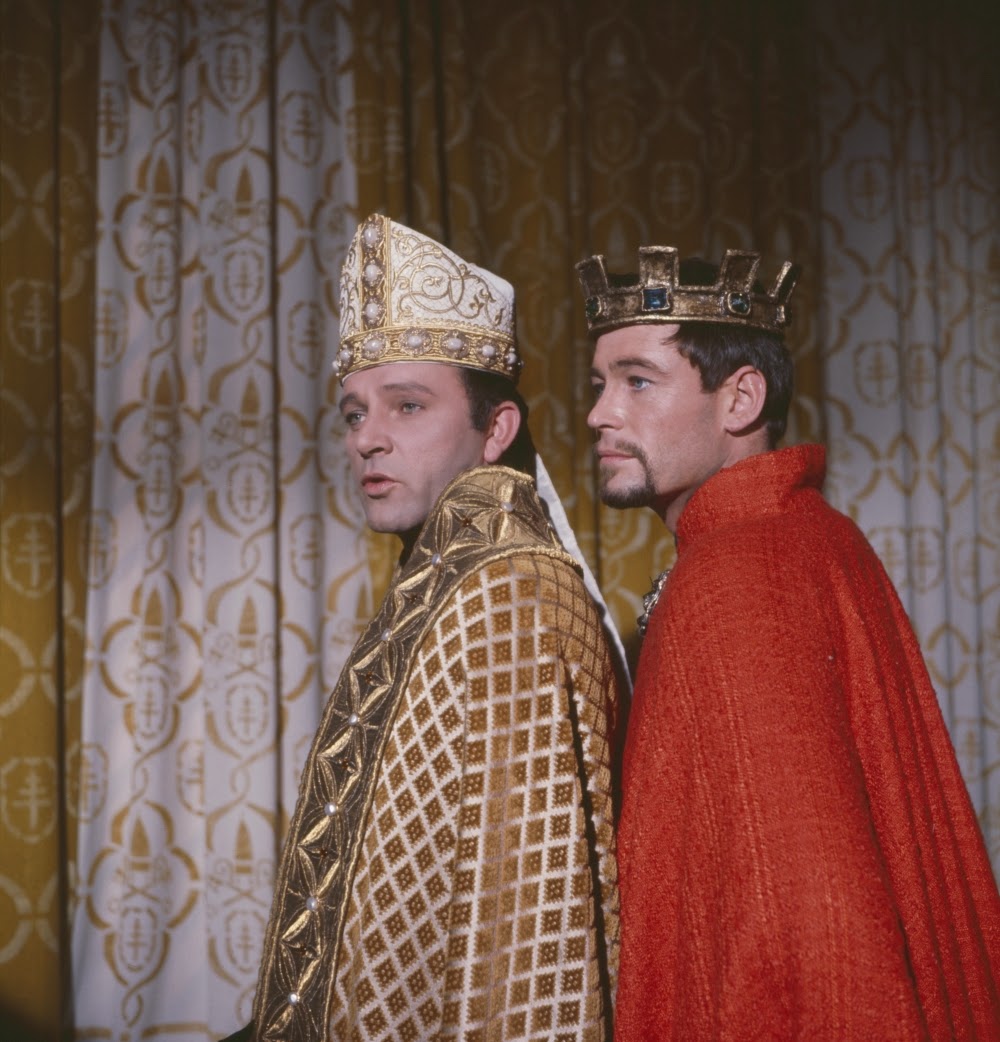
Richard Burton as the Archbishop of Canterbury with
Peter O'Toole in the role of King Henry II in the
1964 Paramount Pictures movie of Becket.
The cope worn by Richard Burton is in part based
on actual vestments of Saint Thomas Becket;
the curtains in the background have a Papal monogram:
the triple tiara and crossed keys.

It is not unusual on this Blog for a work of art to be discussed in the context of the history of sacred liturgy or vestments. This is the first time, however, that there is a discussion of a motion picture. Typically, whenever the rites of the Catholic Church are depicted on the big or small screen, they are represented inaccurately (sometimes laughably so), or even sacrilegiously. An exception to this is the very fine 1964 movie "Becket" produced by Paramount Pictures, and starring the late Richard Burton in the role of Saint Thomas Becket (1117 - 1170), once Chancellor of England and subsequently Archbishop of Canterbury.

This post is not about the life of the Saint, but rather about aspects of the presentation of the rites of the Church depicted in this movie. We find that production design for this movie was in the care of John Bryan; art direction by Maurice Carter; set decoration by Robert Cartwright and Patrick McLoughlin with costume design by Margaret Furse. These people obviously researched the rites and vesture of the Church in the early Mediaeval period quite carefully.

A search of the internet has uncovered some interesting stills of this movie, which are shewn here, together with some commentary. Largely they depict that scene where Becket is consecrated as Archbishop of Canterbury. An interesting description of the Consecration is given here .

Click on the following images for an enlarged view.


At the Profession of Faith.
The consecrating bishop is vested for Mass in full pontificals.
The co-consecrators are vested in matching copes and mitres.
Surrounding the prelates are deacons vested in dalmatics
and young acolytes some vested in albes, some in surplices.
Amice apparels are everywhere.


At the Laying-on of hands.
A detail of the ornamentation of the cope used in the production.
The ornamentation is accurately based on a stole of Saint Thomas
still housed in the Sens Cathedral.


Imposition of the mitre.
The mitres worn are all accurate reconstructions of mitres
worn in the 12th century.
They are small, and their titulus and circulus ornaments are
enriched with jewels.


After the Imposition of the mitre.
A specially printed impression of the Pontificale Romanum 
prepared for the movie is seen here.


The well-designed and finely-worked ornamentation
of all the vestments can be seen here.
Note the blue stole worn by the co-consecrator. The practice of having all
the vestments worn by a celebrant of the same colour is not an ancient one.


At the Enthronement.
The new Archbishop, now dressed in full Pontificals for Mass,
is also wearing the pallium: a fine interpretation of the mediaeval form.
Also clearly seen are the fringed dalmatic and tunic
worn by the consecrating bishop.
We must also take note of the beautiful Western-style iconography
created as a backdrop for the Archbishop's throne:
vigorous and very religious in feeling.


The Final Blessing of the Mass of Consecration.
We are able to see the altar in this photograph, ornamented with
images of the saints and with a tabernacle resting upon it.
This would seem to be the least accurate aspect of this scene from the movie.


The Final Blessing, somewhat over-dramatically depicted.


Years after the movie was made,
the costumes designed by Margaret Furse for Richard Burton's use were auctioned.
This photograph shews the chasuble and dalmatic, with an amice apparel.
The chasuble is a rather free redesign of the famous Becket chasuble
kept even to this day at Sens Cathedral.


The actual chasuble of Saint Thomas Becket,
housed in the treasury of Sens Cathedral.
This image is the copyright of Genevra Kornbluth.


A 19th century engraving of the mitre, chasuble and stole of Saint Thomas
venerated at Sens Cathedral.
These vestments were carefully studied for reproduction in the Paramount movie.
The ornamentation of the ancient stole was replicated as the ornament of
a cope and amice apparel used in the movie, whilst the ornament
of the mitre (see below) was used as the basis for several mitres in the production.


Sunday, 4 May 2014

Saint John Paul II : 2


On 16th October, 1978, KAROL WOJTYLA, Cardinal-Archbishop of Krakow, was elected Pope by the College of Cardinals and took the name John Paul, in tribute to his immediate predecessor. His election had not been expected and few people had ever heard of him.

After several years of debilitating ill-health, Pope John Paul died on 2nd April, 2005 at the age of 84, and was buried in S' Peter's Basilica. After his death, he was dubbed popularly, John Paul the Great.  His successor, Pope Benedict XVI, Beatified John Paul II on 1st May, 2011.

On a memorable Roman day, 27th April, 2014, John Paul II was canonised in Saint Peter's Square.

This post includes some liturgical images of Blessed John Paul II.  They illustrate the changed aesthetic for Papal vestments which emerged during the 1980's and 1990's. The austerely decorated and unlined papal vestments of the 1970's were set aside in favour of vestments which were more imaginative in design, rich in colour and made from better quality fabrics.

Click on the images for an enlarged view.

Ash Wednesday in the Basilica of Santa Sabina.
A magnificant cope in violet silk, decorated with handwork in silver.
The mitre matches the vestments, being suitably sombre for Lent.


A chasuble of violet dupion-silk.


Pope John Paul II wearing an elaborate chasuble of green, beautifully ornamented.
The chasubles used by John Paul II  during the course of his
Pontificate became increasingly more ornate,  and well-designed,
setting aside the austere Papal aesthetic of the 1970's.


A quite different chasuble in an unusual shade of green.
A mitre tastefully decorated with handwork.
The more tasteful Papal aesthetic of the 1980's and 1990's.


A somewhat rare occasion:
Pope John Paul in full Pontificals of the Roman style
including the Papal fanon.


A Papal Mass on the Feast of Ss Peter and Paul.
The Pope is wearing a reproduction of the well-known Four Evangelists mitre.


Easter in the year 1999.
A special form of the pallium was used - only once - by the Pope.
See the photograph below.


An exhibit in the Vatican Museum which shews the
special pallium which had been made for the use of Pope John Paul.
The pallium was only used the once.
Visually, it is superior to the different forms of pallia used by Pope Benedict.


Coat of Arms of Saint John Paul II


The Funeral of Pope John Paul II in Saint Peter's Square
8th April 2005: one of the most famous funerals in history.


The casket bearing the mortal remains of John Paul II
is venerated by the members of the College of Cardinals
in S' Peter's Basilica on the day of his
Beatification, 1st May 2011.