Saturday, 20 March 2021

Violet vestments

Violet vestments
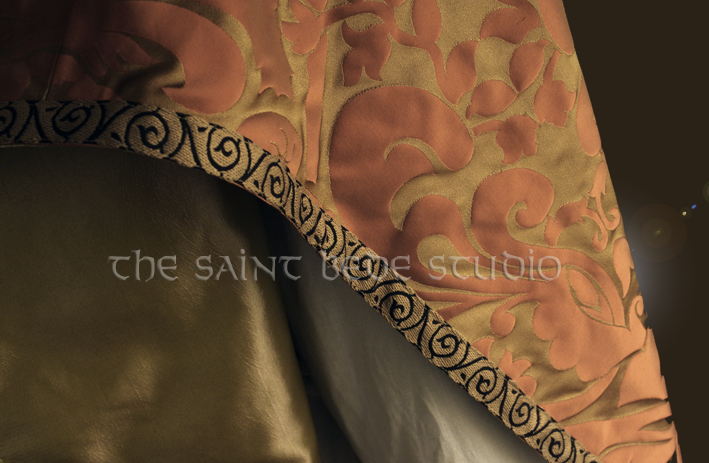
In this post, we feature a set of vestments made in our range of economy vestments.  This particular style is called Saint Anselm and they were made for a returning customer from the Archdiocese of Anchorage (USA).

The vestments are made from a lovely shade of violet dupion silk and ornamented with a column, back and front, formed from the Studio's unique braids.  The chasuble is unlined, but faced around the neckline to make it sturdy and comfortable to wear.  Other accessories of the set were fully lined.

The Saint Bede Studio


These vestments were specially designed for use during Masses for the Dead.  They are equally suitable, however, during the Season of Lent.

Click on the images for an enlarged view.

Enquiries : stbede62@gmail.com


Lux Aeterna


The Saint Bede Studio

Tuesday, 16 March 2021

The Memoriale Rituum (re-posted)

Memoriale Rituum
The following is a translation of the Preface to a small liturgical book from times past titled the Memoriale Rituum  :


A Particular Congregation for determining certain matters concerning the Sacred Visitation of the parochial Churches in Rome was held by our Holy Father Pope Benedict XIII. on 4th December 1724.

The visible signs of religion and piety are rites and holy ceremonies by which the minds of the faithful are drawn to the contemplation of spiritual things.

His Holiness in the aforesaid Congregation confirmed a Decree ordering this Memoriale Rituum to be printed and to be observed by Rectors, in order that uniformity and exactness might be secured in the smaller parochial Churches in Rome, and at the same time to guard against omissions - by reasons of the fewness of clergy or insufficient knowledge of ceremonies - of those ceremonies by which our Holy Mother the Church brings to our remembrance the most noteworthy of [being] the mysteries of the Passion.

The Memoriale combines exactness of rites with a very small number of servers. *  Generally three are sufficient, four being seldom necessary.  It is the duty of the parish Priest to give timely instruction to these servers, in order that that they may act quickly, but with attention, and so prevent aimless wandering to and fro.

He will teach them also those Psalms, Antiphons and Hymns which are to be recited or chanted in procession, endeavouring to obtain vocal uniformity; hence for greater convenience these Antiphons, etc., are inserted in the Memoriale, each in its own proper place, so that one and the same book contains directions as to what is to be done and also those Hymns, etc., which are to be recited.

Six functions occur in the course of each year are here set out :

Part I       The Blessings of Candles on the Feast of the Purification of the Blessed Virgin Mary.
Part II      The Blessing of Ashes at the Beginning of Lent.
Part III     Palm Sunday.
Part IV    Thursday, the Day of the Lord's Supper.
Part V      The Friday of the Passover.
Part VI     Holy Saturday.  

From these it will not be difficult to deduce a method for carrying out similar functions, so that in all things and at all times due regard for the sacred ceremonies may always be apparent.

In the Latin, the term presumes the servers are clerics.

Only 150 years after the publication of the Missale Romanum by Pope S' Pius V, this interesting document describes the state of the Sacred Liturgy in the churches of the City of Rome.  It would seem that, although the Rites of Holy Week - and other important Feasts of the Year to which were attached particular rites - were detailed in full in the Missale Romanum, the observance of these Days had generally degenerated and required a reform.

What was intended as a Ritual guide to be observed only in the city of Rome, came to be used world-wide.  It was especially important for missionary countries and rural churches which had but one priest and a small group of altar servers.  This was a provision for smaller churches which did not have the means to celebrate these Rites in their fuller solemnity.  It was a small book obviously intended to be hand held by the celebrant and his ministers.  The Memoriale Rituum was published in several editions and in translations, the last being published by the Holy See in 1950.

Noteworthy in this ritual guide is that, although it was preferred that the Rites would be sung, it was nevertheless permitted that they be read (either in part or entirely) or sung recta tono with some inflections. The Memoriale Rituum does not seem to envisage any choir chanting the rites - for example, the hymns, antiphons, psalms, but that they be chanted by the Celebrant and his ministers.

In the midst of the fashionable pre-occupation amongst Traditionalists at present with the use of the pre-1955 Rites of Holy Week, it is important to remember that the rites detailed in the Memoriale Rituum were the usual observance of Holy Week throughout the entire Church.  In greater churches, monasteries &c., the more solemn celebration of these rites, as detailed in the editions of the Missale Romanum would - of course - have been observed.

When the reformed rites of Holy Week were first celebrated in 1956, the rites as detailed in the Memoriale Rituum were suppressed.  Furthermore, the Restored Rites of 1956 allowed for a solemn or simple celebration of Holy Week, but they were always to be sung : there was no permission for a form of Holy Week which was read.

Wednesday, 10 March 2021

Laetare Sunday 2021

Saint Bede Studio
For an esteemed American customer, the Saint Bede Studio recently completed this distinctive set of Rose vestments.  The set was completed in the Saint Philip Neri style, being the Studio's interpretation of the 16th century form of the chasuble.

These vestments were made from a beautiful silk damask with a lighter rose figured ornament on a ground of green-gold.  The lining of taffeta was selected to match the colour of the damask ground-colour.

Rose vestments

Because of the particular characteristics of this damask, a simple ornament was chosen, being an outlining braid arranged in the Roman manner.

Click on the images for an enlarged view.

Enquiries : stbede62@gmail.com

Rose vestments


Saint Philip Neri

Tuesday, 2 March 2021

Purple vestments in the Season of Lent


The Studio recently completed this set of purple vestments (shewn in the adjacent image) which forms part of a benefaction to the Church of Saint Thomas of Canterbury, Lewisham (Archdiocese of Sydney).  

This historic church underwent a comprehensive restoration and refurbishment 2016 - 2017, for which the Saint Bede Studio was a consultant.


These attractive vestments - intended for the Season of Lent - were made from a lovely ecclesiastical brocade in fuchsia-purple and were lined in a  crimson-red taffeta. The chasuble is in the Studio's 
Saint Benet style, being a variant of the Gothic Revival form. The ornament is formed from one of the Studio's braids re-worked from the designs of AWN Pugin by the Studio, in colours of blue and gold upon red.

Click on the images for an enlarged view.


Enquiries : stbede62@gmail.com


The Saint Bede Studio
View of the High Altar of the Church of Saint Thomas
of Canterbury, Lewisham (Australia).
Ornamental work on the sanctuary wall was designed by
The Saint Bede Studio as part of the restoration works
on the church.

Image : The Saint Bede Studio.

Wednesday, 17 February 2021

Saint Philip Neri vestments

In this post, we are pleased to describe a set of vestments in the style of Saint Philip Neri, which was commissioned by a returning customer from the  USA.

These vestments were made from a silk lampas in a rich and darker shade of red and ornamented with a brocade in crimson-red and straw-gold.  A braid outlines the ornament front and back.  The lining of these vestments was formed from a bronze-shade of taffeta.

Click on the images for an enlarged view.

Enquiries : This page.


Tuesday, 9 February 2021

The Bidding Prayers : 1

The Constitution on the Sacred Liturgy of the Second Vatican Council Sacrosanctum Concilium laid down the desire of the Fathers for the restoration of intercessions:

53. The “common prayer” or “prayer of the faithful” is to be restored after the gospel and homily, especially on Sundays and holidays of obligation. By this prayer - in which the people are to take part - intercession will be made for holy Church, for the civil authorities, for those oppressed by various needs, for all mankind, and for the salvation of the entire world.

This paragraph made reference to Saint Paul’s admonition at 1 Tim. 2:1-2. This paragraph is found – with only slight alterations – in the General Instructions on the Roman Missal.

Such intercessions are, therefore, of Apostolic origin, and were everywhere known by the time of Saint Augustine. The Solemn Orations of the Good Friday Afternoon Liturgy were the only survival of such intercessions in the Roman Missal for centuries. In the East, however, they were preserved in the unvarying Litanies, or Ektenia that are prayed throughout the celebration of the Divine Liturgy. From the East, such intercessions made their way during the first millennium into the various Rites in England and, centuries later, were incorporated into the Services of the Church of England, long after they had ceased being a usual feature of the Roman Rite.

Anciently, the intercessions formed part of non-Eucharistic prayer service (sometimes called a Synaxis). But when such services came to be usually celebrated immediately before the Eucharistic Liturgy, the intercessions gradually fell into disuse. This was because intercessions made during the Eucharistic Liturgy often repeated those found in the Synaxis. Such was the origin of the Roman Mass being described in two parts: the Mass of the Catechumens and the Mass of the Faithful.

What is found in almost all the ancient examples of these intercessions are common intentions, which were summarised and made explicit by the Fathers of the Second Vatican Council.

It was never envisaged by the Council - nor was it part of the ancient practice - that such intercessions vary on a daily basis, nor that there be any inclusion of extemporaneous prayer. It might easily be argued that the Council Fathers wished that these intercessions would become fixed in people’s consciousness, by being prayed week after week. Such is the practice with our Eastern brethren.

Upon this simple concept outlined by the Council Fathers, there have been many accretions over the last 50 years. Not uncommonly, we find intercessions anaemic in their theological content and not specifically Christian in their outlook. We commonly find the intercessions to be linked to the Propers of the Mass, and the lections of the Mass of the Day, as if “theme” were all-important. But this was never intended by the Council Fathers. Furthermore, a new and more noble translation of the Roman Missal for the English-speaking world has highlighted the often unsacral, even trite expression of these intercessions. But even the formulae found in the Roman Missal are so terse as easily to be described as bland.

Further posts in this small series will examine some forms of Intercession drawn-up immediately after the first liturgical reforms of the Second Vatican Council.

Saturday, 6 February 2021

Mitre in honour of BVM

Mitre
Recently, the Saint Bede Studio completed a mitre for an esteemed customer, being intended as a gift for a bishop in New Jersey (USA).

The mitre was made from a white jacquard with small woven fleur-de-lis and ornamented with dupion silk in a lovely shade of blue.  The circulus and titulus of the mitre were formed from this dupion silk and a golden galloon.  The lining of the mitre and of the lappets were also made from the same dupion silk.

Click on the images for an enlarged view.

Friday, 29 January 2021

Priestly Ordinations 2020 : 3

The Saint Bede Studio
In this post, we are pleased to describe a set of vestments in the Saint Bede Studio's Saint Austin Gothic Revival style, which was commissioned by an ordinand from Vancouver, Canada.

These vestments were made from an ecclesiastical brocade in a lovely shade of green and ornamented with one of the Studio's unique braids.  The lining of these vestments was formed from a brassy-gold shade of taffeta.

Please pray for all newly-ordained priests.

Click on the images for an enlarged view.

Enquiries : This page.

Green Gothic Vestments


Green Gothic Revival vestments


Saturday, 23 January 2021

Orphrey braids of the Saint Bede Studio

Each year, the Saint Bede Studio adds to its column of orphrey braids.  Most of our braids are derived from precedents, either Gothic Revival or Mediaeval. They are never merely copies, but always have original touches to enhance the diversity of their use.

These unique braids are designed by the Studio and only used in conjunction with our vestments. They are not commercially available, nor available to any other vestment makers and are reserved under international copyright. *

The braids shewn in the adjacent image are used for orphreys in both the Gothic and Roman  styles of vestments designed and made by the Studio.


A key to the illustrated braids :

  1. Maria Regina
  2. English Rose
  3. Saint Columba
  4. Chi Rho
  5. Saint James
  6. Stella
  7. Saint Marie
  8. Saint Austin
  9. Welbye
  10. Saint George
  11. Saint Edmund (green/red)
  12. Salisbury
  13. Saint Edmund (silver/red)
  14. Saint Chad (green/red)
  15. Saint Giles
  16. Rosa Antiqua
  17. Lux Aeterna
  18. Saint Dunstan
  19. Saint Chad (blue/red).

Click on the image for an enlarged view.

Enquiries : stbede62@gmail.com


~~~~~~~~~~~~~~~~~~~~~~~~~~~~~~~~~~~~~~~~~~~~~~~~
* This measure has been necessary because of an unpleasant experience in which a manufacturer misappropriated one of the Studio's unique designs and then sold it for his own commercial gain.

Sunday, 17 January 2021

Deaconesses and Recent Difficulties

In May of 2016 we heard that the tired subject of a "female diaconate" had been raised again, but this time - most disappointingly - by the Bishop of Rome who, in an "impromptu" remark during a meeting with Religious gathered in Rome, claimed that the history of deaconesses in the Early Church is "obscure".  In August 2016, the Vatican Bulletin announced the formation of a Commission to study this, which the Pope has decided upon "after intense prayer and mature reflection". *

The history of deaconesses in the Early Church is only obscure to those who either have not studied the issue, or to those who are determined to force such an innovation upon the Church.  The Commission did meet and did not support the introduction of a female diaconate based upon the practice of the Early Church.  That was in 2018.  But then in 2019, the agitators were at it again and as has become notoriously obvious, the promoters of this innovation will not accept "no" as the answer.

Giotto's 13th century depiction
of Saint Stephen the protomartyr
and deacon.
The history of deaconesses in the early Church was the focus of a definitive study published in 1982 by the distinguished French liturgiologist, Monsignor Aime-Georges Martimort.  Ignatius Press published a translation of this wonderful work in 1986 Deaconesses : An Historical Study, which is still in print. I urge you to obtain this book and read it (it assumes a working knowledge of Greek and Latin). It also appears to be available to be read online.

But, above all is to be noted the deliberations of a previous Commission of the Holy See into this very subject, published only 14 years ago and which may be read in full here.

Deaconesses DID exist in the Early Church but they WERE NOT female deacons. Their ministry was narrowly defined, completely distinct from the ministry of the deacon and DID NOT include any liturgical role at the altar, where, according to Apostolic Tradition, no woman set foot. This is not what present-day advocates of deaconesses are seeking. They are seeking the feminisation of the Church's Orders and a ministry at the altar. This is not Tradition, it is innovation.

This week past, motu proprio, the Bishop of Rome has made another change to a discipline of Apostolic origin.  The argument that the Offices of Lector and Acolyte can be considered in distinction from the Orders of Deacon and Priest is not a Catholic approach, and represents a rupture with Tradition.  What this will create for the Church we cannot be certain, but we do have a clue, being what has happened within the Anglican Communion over the past 40 years.

What separates the Orders of the Roman and the Eastern Churches from the ministries of Protestant denominations is Apostolic Tradition.  We compromise that link to our great peril.  One of the insights of the Second Vatican Council was to emphasise that the laity has roles and responsibilities which complement and yet are distinct from Ministry at the altar.  We could start with the spreading of the Gospel in this age of Unbelief.  Yet here we are almost 60 years later, still talking about why it is "urgent" that lay men and women minister at the altar.

-------------------------------------------------
* These are the actual words of the Vatican Bulletin and presumably are not intended to be ironic.