Friday, 25 March 2022

On this Feast of the Blessed Virgin

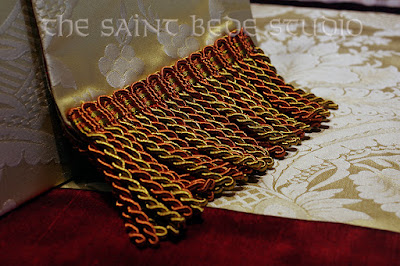
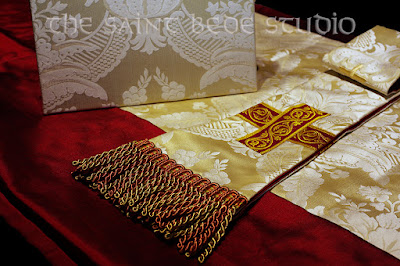
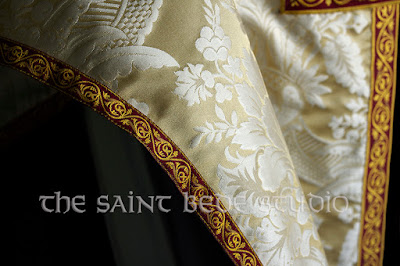
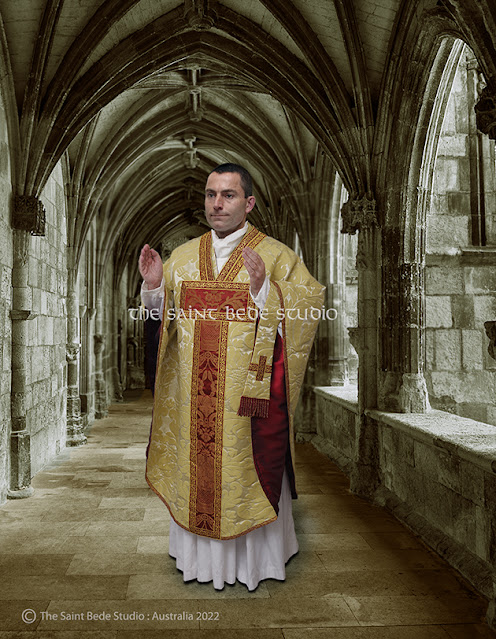
On this beautiful Feastday of the Annunciation, the Saint Bede Studio is pleased to post these images of a set of vestments we completed recently for a returning customer from the United States.

The set of vestments, often seen on the Studio blog, we call Ave Maris Stella.  It is based on designs of the famed genius of the Gothic Revival AWN Pugin.

The vestments were made from a shade of ivory silk damask and lined in Royal Blue taffeta.

Please click on the images for an enlarged view.


Sub tuum praesidium confugimus, 
Sancta Dei Genetrix. 
Nostras deprecationes ne despicias in necessitatibus, 
sed a periculis cunctis libera nos semper, 
Virgo gloriosa et benedicta. Amen.

Thursday, 24 March 2022

A Prayer to the Mother of God

BENEATH YOUR PROTECTION, O holy Mother of God and ever-virgin Mary, we place ourselves, trusting that no earthly trouble is hidden from your tender care. 

MOST HIGHLY-FAVOURED LADY, amid the misery of our sinfulness, weakness and failures, you never cease to remind us that the bountiful God does not abandon us, but continues to look upon us with love, ever-ready to forgive and restore us to new life, if we but turn to Him in repentance. 

ACCORDING TO HIS LOVING PURPOSE, you are ever with us, O Virgin Mary, and in our most troubled moments, you guide us with your motherly concern. God has given you to us and made your Immaculate Heart a refuge for the Church and for the entire human race. With confidence, therefore, we now turn to you, knocking upon the door of your tender heart. 

CLOSE NOT YOUR EARS to our supplications, O blessed Mother, nor delay to come to our aid but untie the knots of our hearts and of our world. At this dark hour, help us and grant us your comfort, for we place our trust in you. 

STAR of the SEA, guide us, lest we be shipwrecked in the tempest of war. 

O PITYING MOTHER, may your intercession soften men’s hardened hearts. Amid the thunder of weapons, may your prayers, O Queen of Peace, turn men’s thoughts away from war. May the tears you shed over our strife make this vale of tears - scorched by hatred and violence - blossom anew. May your maternal embrace comfort those forced to leave their homes and their native land, fleeing from the lords of war. May your sorrowing Heart move us to compassion for our brothers and sisters, God’s children, who are injured and cast aside. 

PILLAR OF JUSTICE, bring to repentance those who have brought misery through the violence of war. 

A WEARY and FEARFUL WORLD stands with you beneath the saving Cross, needing to entrust itself to you, O Heavenly Mother, and, through you, to dedicate itself to Christ. Under your protection we place the Faithful of the Ukraine and Russia, who venerate you with great love, even as your heart beats with compassion for them and for all those peoples ravaged by war, cruelty and poverty. 

INSPIRED WITH DEVOTION and CONFIDENCE, therefore, O holy Mother of God and ever-virgin Mary, we entrust and dedicate ourselves, the Church and all mankind, but especially the Ukraine and Russia, to your Immaculate Heart. To you we dedicate the future of the whole human family, the needs and expectations of every people, the anxieties and hopes of the world. Through your intercession, may God’s mercy be poured out upon the earth and the gentle rhythm of peace return to mark our days. 

O GRACIOUS QUEEN of HEAVEN, restore God’s reign within our hearts and to this troubled world. Amen.

-o-o-o-o-o-o-o-o-o-o-o-o-o-o-o-o-o-o-o-o-o-o-o-o-o-o-o-o-o-o-o-o-o-

PLEASE NOTE :

This is a recension of the Act of Consecration issued by the Holy See for the corporate prayer of the Catholic Bishops of the world on the Feast of the Annunciation.  The text above is purely for personal devotional use, whereas the text of the Act issued by the Holy See is intended to be a public prayer, fulfilling the requests of our Lady during the Fatima Apparitions.

Saturday, 19 March 2022

Vestments for the Penitential Seasons 2022 : 2

Violet vestments
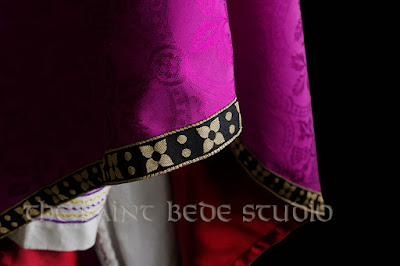
In this Holy Season, we are pleased to present a set of penitential vestments, made for a returning Australian customer.

These vestments were made from an English ecclesiastical brocade, in a rich shade of violet and lined with a taffeta red in colour.  The vestments were ornamented in the Roman manner with the crimson red damask, outlined with a galloon in colours of burgundy and grey and a narrow galloon of the same colours.

Please click on the images for an enlarged view.

Enquiries.

The Saint Bede Studio


Saint Philip Neri chasuble


The Saint Bede Studio

 AMDG.

Saturday, 5 March 2022

Vestments for the Penitential Seasons 2022 : 1

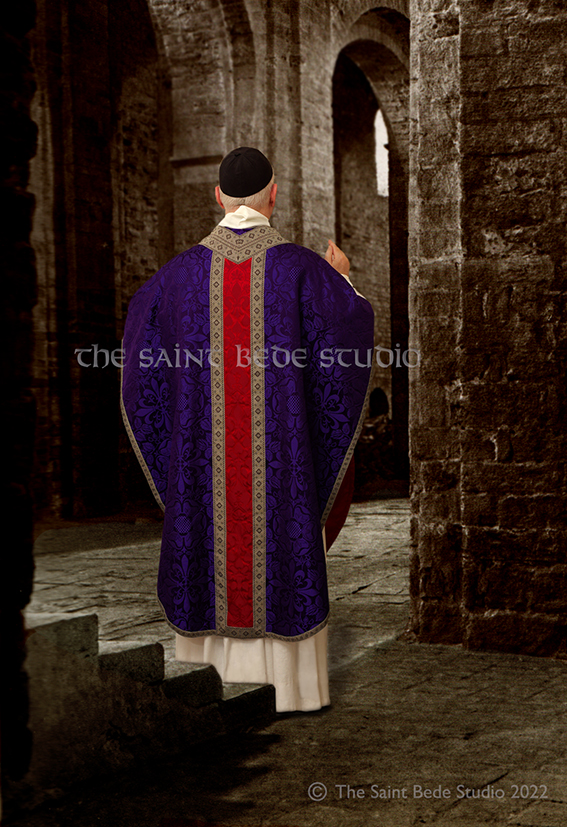
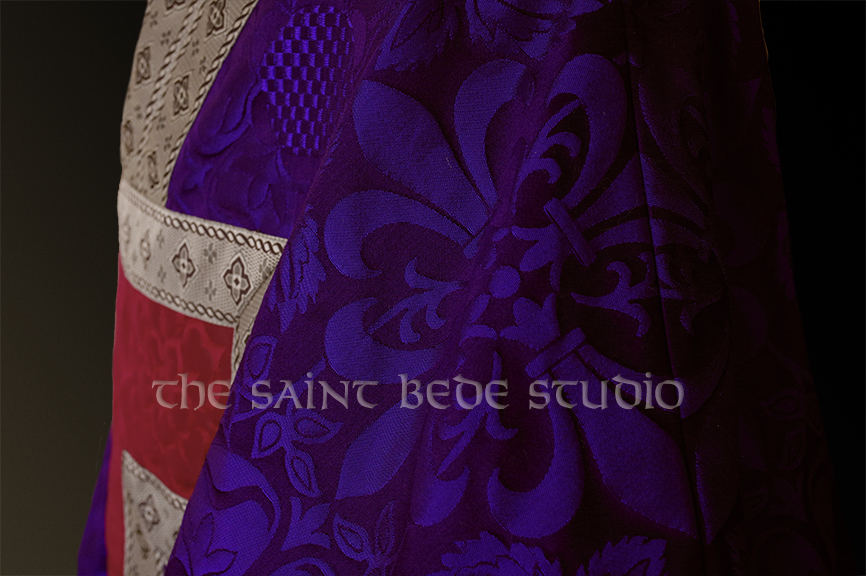
Purple vestments
At the beginning of this Holy Season, we are pleased to present a set of penitential vestments, made for a returning customer from the Archdiocese of New York.

These vestments were made from an English ecclesiastical brocade, in a shade of Roman purple and lined with a taffeta deep-red in colour.  The vestments were ornamented with the Studio's unique braid Lux Aeterna in colours of black and taup and a narrow galloon of the same colours.

Please click on the images for an enlarged view.

Enquiries.


Purple vestments

The Saint Bede Studio


Purple vestments


Tuesday, 1 March 2022

The Agony of the Ukraine


Let us all unite in prayer on this particular Ash Wednesday for the cessation of hostilities in the Ukraine.

Thursday, 24 February 2022

To What End Sacred Vestments?

Solemn Mass at the Abbey of 
Saint Madeleine, Le Barroux.
If we were to accept the notion that a priest is the "president of the christian assembly" then what he wears to celebrate the Sacred Liturgy would be merely an expression of his personality or tastes. The notion of presider is an entirely modern (and an execrable) concept. A priest, bishop or Pope celebrates the Sacred Mysteries. In the East, the term used is to serve.

Because the celebrant is least of all a "presider", what he wears should not essentially be about his own preferences and personality. A priest should ask of himself :

Is what I am wearing worthy of my ministry standing between God and man to offer the Holy Sacrifice?

Will what I am wearing draw those who look upon me during Mass into a closer appreciation of the Sacred Mysteries, in other words, will it raise their hearts and minds to God?

Or will it act as a distraction to the Faithful attending Mass?

Wednesday, 9 February 2022

The Ethos of the More Ancient Use of the Roman Rite

In 1970, when the New Order of Mass was introduced, much was changed pertaining to the celebration of Mass and everything associated with it. The nature of the Mass, of course, did not change, but how it was presented changed very markedly. It was far more than a change from Latin to English: it involved a change in emphasis. In trying to simplify the Sacred Liturgy and make it more readily comprehensible, the architects of the New Order of Mass emphasised the communal aspect of the Mass. Typically, the celebrant stands on one side of the altar, facing the congregation, and all are gathered around the table of the Lord, to partake of the Sacred Banquet. Very often there is a strong emphasis on active external participation. 

When the celebrant is not facing the congregation, however, the entire atmosphere of the Mass is changed: both priest and people are facing the same direction to pray. Many have forgotten that from earliest Christian times, Mass was celebrated looking towards the rising sun (a great symbol of the Resurrection, and of Christ’s Second Coming in Glory) : everyone faced this direction. Furthermore, the Mass is not limited to the confines of the building in which it is being celebrated, but is a cosmic event, involving the angels and saints and the souls of the faithful departed who are yet to receive their eternal reward. Simply by changing the position of the celebrant, a different sense of the Mass as a sacred event is conveyed to all present. The great silences, the solemn ritual actions of the celebrant and the beauty of the ancient Latin prayers, all reinforce the mysterious and sacred atmosphere of this More Ancient Use of the Roman Rite. 


The sense of the sacred is not only manifest in the celebration of the Liturgy itself, but in all the things that surround it: the way the celebrant is vested, the manner in which the altar is decorated, the manner in which the celebrant and his ministers conduct themselves in the sanctuary - all of these things are governed by rules which the Church in her wisdom adopted over the course of centuries. 

The vestments, designed for use in the Sacred Liturgy, are required to be blessed. The colour of these vestments varies according to the liturgical season or feast: violet and purple for Advent and Lent; white for Christmas, Easter and Saints’ days; red for Pentecost and for the Apostles and Martyrs; green for the time before Lent and after Pentecost; rose for the mid-point Sundays of Advent and Lent and black for Masses of the dead. 

Just as the celebrant puts on vestments for the Sacred Liturgy, so, too, the chalice and the altar are vested. The altar, which signifies Christ himself and upon which the Sacrifice of the Mass is offered, is vested in a frontal which matches the colour of the celebrant’s vestments. Upon the altar, three cloths made of linen rest. In the middle of the altar a large Cross is placed between the candlesticks. The number of candles is graded according to the solemnity of the occasion, two, four or six. 

The Church has regulated all these things, in order to create a certain image around and to preserve a certain attitude to the Mass. There are other things concerning the More Ancient Use of the Roman Rite about which the Church has made certain regulations; such things are also designed to preserve the sacredness of the Mass and the sanctuary where it is celebrated. At this form of Mass, those receiving Holy Communion must do so on the tongue, not in the hand. Unless there is some disability, those receiving Holy Communion should kneel before the altar at the Communion rail. The same laws of fasting which govern the New Order of Mass also govern the More Ancient Use of the Roman Rite.

An extract from The Order of Mass compiled by the Saint Bede Studio and published in 2008 by the Ignatius Press.

Tuesday, 8 February 2022

Too Many Words

Pope S. Paul VI at the Yankee Stadium NY 1965.
One of the characteristics of the Roman Rite until the introduction of the Missal of Pope Paul VI in 1970, was the balance it achieved between silence, singing, the spoken word and ritual action. Even the so-called Interim Rite, which had various iterations between 1964 and 1968, still preserved much of this balance.  The Roman Rite "spoke" to people on a number of levels, not just the cerebral level. Its silences spoke, its aesthetics spoke, its unique and unworldly music spoke.

On the other hand, one of the great flaws of the Missal of Pope Paul VI is that it is far too cerebral. Everything has to be comprehensible intellectually. The Council Fathers decreed that the Church's Rites had to be "intelligible", but unhappily, the new Missal took this injunction too far.

The typical celebration of the New Mass, Ordinary Form - call it what you will - is very wordy. If the texts in the Missal itself weren't more than enough, we are also subjected to little commentaries, entertainments, even ferverini during the Mass.  There is the Three Sermon Syndrome, where the celebrant speaks at the beginning of the Mass, after the Gospel and then before the Last Blessing. Words, words, words. Too many words.  How can one encounter the transcendent with so many words?

At the same time, ritual action in the New Order of Mass has been reduced to a minimum. Silence is imposed by the celebrant, rather than being organic to the rite. One strange example of this, which we suffer too often, and which has become the touchstone of the more contemporary ars celebrandi, is where the celebrant - having preached his homily - goes and sits down and a period of silence is endured. Presumably we are to meditate on his spoken wisdom: but does anyone remember more than two sentences that he said?  How quintessential such a made-up ritual is to the inward-looking and artificial ethos of the New Order of Mass.

Let us be very careful to avoid an overly-cerebral approach to the Sacred Liturgy (New or Old).  Might we not aim, rather, to recapture and preserve that old balance of the Roman Rite: silence and song supporting the Ritual actions?

Tuesday, 25 January 2022

Priestly Ordinations 2021 : 4

Saint Philip Neri
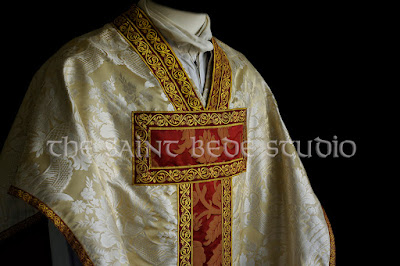
In this post, we are pleased to describe a set of vestments in the Saint Bede Studio's Saint Philip Neri style, which was commissioned by an ordinand from the Philippines.

These vestments were made from a lightweight silk
damask in lovely shades of ivory and straw-yellow.  The ornament, in the Roman manner, was formed from a damask in colours deep red and old gold, trimmed with one of the Studio's unique galloons.  The lining of these vestments was formed from a deep red shade of taffeta.

Please pray for all newly-ordained priests.

Click on the images for an enlarged view.

Enquiries : This page. 

Saint Philip Neri


The Saint Bede Studio


The Saint Philip Neri

AMDG

Tuesday, 11 January 2022

Priestly Ordinations 2021 : 3

Borromeon vestments

In this post, we are pleased to describe a set of vestments in the Saint Bede Studio's Borromeon style, which was commissioned by an ordinand from the United States.

These vestments were made from a damask in lovely shades of ivory and straw-yellow.  The ornament, in the Roman manner, was formed from a damask in colours deep red and old gold, trimmed with one of the Studio's unique galloons.  The lining of these vestments was formed from a deep red shade of taffeta.

Please pray for all newly-ordained priests.

Click on the images for an enlarged view.

Enquiries : This page.


The Saint Bede Studio


Borromeon vestments


The Saint Bede Studio