Sunday, 17 April 2022

Paschal Greetings 2022

To all readers of this blog and to customers and friends of the Saint Bede Studio, may many Graces be yours on the Day of our Lord's Resurrection.

On Easter Day 2022, the Shadow of the Cross looms large across a world still stricken with plague and war.  But in these fearful moments, we look again to the optimistic Christian message that God has overcome Death - and all the awfulness, frailties, discord and disappointments of this earthly life - and loves each and every poor sinner. 

Christ is Risen !

Friday, 15 April 2022

On Good Friday

On this Good Friday, we wish to feature this set of black vestments, completed for a returning customer, in the Saint Philip Neri style.

The vestments are extremely simple, but in the classic Roman style of ornament. A black damask was used for these vestments, ornamented with silver braids and lined in charcoal-grey taffeta.

Please click on the image for an enlarged view.

Enquiries : stbede62@gmail.com
 

Black vestments


Black vestments

Saturday, 9 April 2022

The Mandatum - revisited

A 19th century engraving depicting the Pope, surrounded
by the Papal Court washing the feet of thirteen
poor men of Rome.
This rite took place in the Sistine Chapel on the
morning of Maundy Thursday.
The practice of the present Bishop of Rome to celebrate the Evening Mass of the Lord's Supper outside of the chapels and basilicas of the Vatican and in places which are not churches, but prisons or hospices, continues to catch the attention of the world. The Pope's decision to wash the feet of girls (as well as boys) and non-Christians during the Mandatum has variously attracted perplexity and rapture.

An analysis of the merits of these divergences is not the purpose of this post. Rather, we wish to give an outline of the history of the Mandatum in order to present reasons why the significance of the Rite is open to different interpretations and philosophies.

The Catholic Encyclopædia (1907-1914) has an article on the history of the Mandatum, written by Herbert Thurston SJ, of which the following is an extract.  Father Thurston had written previously about the Mandatum in his monograph Lent and Holy Week (1904):

This tradition, we may believe, has never been interrupted, though the evidence in the early centuries is scattered and fitful. For example the Council of Elvira (A.D. 300) in Canon 48 directs that the feet of those about to be baptised are not to be washed by priests but presumably by clerics or at least lay persons. This practice of washing the feet at baptism was long maintained in Gaul, Milan, and Ireland, but it was not apparently known in Rome or in the East. In Africa the nexus between this ceremony and baptism became so close that there seemed danger of its being mistaken for an integral part of the rite of baptism itself (Augustine, Ep. LV, Ad Jan., n. 33). Hence the washing of the feet was in many places assigned to another day than that on which the baptism took place. In the religious orders the ceremony found favour as a practice of charity and humility. The Rule of St. Benedict directs that it should be performed every Saturday for all the community by him who exercised the office of cook for the week; while it was also enjoined that the abbot and the brethren were to wash the feet of those who were received as guests. The act was a religious one and was to be accompanied by prayers and psalmody, "for in our guests Christ Himself is honoured and received". The liturgical washing of feet (if we can trust the negative evidence of our early records) seems only to have established itself in East and West at a comparatively late date. In 694 the Seventeenth Synod of Toledo commanded all bishops and priests in a position of superiority under pain of excommunication to wash the feet of those subject to them. The matter is also discussed by Amalarius and other liturgists of the ninth century. Whether the custom of holding this Maundy (from Mandatum novum do vobis, the first words of the initial Antiphon) on Maundy Thursday, developed out of the baptismal practice originally attached to that day does not seem quite clear, but it soon became a universal custom in cathedral and collegiate churches. In the latter half of the twelfth century the pope washed the feet of twelve sub-deacons after his Mass and of thirteen poor men after his dinner. The Caeremoniale Episcoporum (1600) directs that the bishop is to wash the feet either of thirteen poor men or of thirteen of his canons. The bishop and his assistants are vested and the Gospel Ante diem festum paschae is ceremonially sung with incense and lights at the beginning of the function. Most of the sovereigns of Europe used also formerly to perform the Maundy. The custom is still retained at the Austrian and Spanish courts.
A number of points may be made here.  Although the origin of the Mandatum is a Divine Precept, which the Church has since earliest times considered binding, its expression and its symbolism are by no means clear in liturgical history. On the one hand, it is associated with the Catechumenate, on the other hand with the poor; yet again, a demonstration of the attitude of service which a bishop or religious superior ought to have towards his community.

The question of the Mandatum being linked to Ordination to the ministerial priesthood is somewhat less clear, although it is often spoken about.

What is quite clear, amongst various uncertainties, is that throughout its history, the Mandatum had no relationship with ordinary parish life: it was a rite which pertained to the Diocesan Cathedral or Church of a Religious Community.  Only since 1955, with the revisions of the Holy Week Liturgy approved by Pope Pius XII, has the Mandatum been included in the ceremonies of the Evening Mass of the Lord's Supper on Maundy Thursday and consequently, celebrated ordinarily in parishes. Perhaps this revision was not as laudable as was thought at the time.

In the last two decades, we have witnessed the spectacle of all sorts of curious and frightful additions to the Mandatum, advocated by tinpot liturgists (we will refrain from describing any of these dismal accretions).  And so, the symbolism of this ancient rite has become obscured again.  An unfortunate by-product of this trajectory is that the real focus of the Evening Mass of Maundy Thursday - the Institution of the Blessed Eucharist and Ministerial Priesthood - becomes obscured.

Happily, we note that in both the Ordinary and Extraordinary forms of the Roman Rite, the Mandatum is OPTIONAL.  In the more ancient (pre-1955) rites of Maundy Thursday, as we noted, the Mandatum is reserved to the local Bishop's celebration of Holy Week.  Its being observed at a time other than during the Evening Mass of the Lord's Supper on Maundy Thursday is something which, we might suggest, might be given serious consideration. Were that to happen, perhaps it would be of lesser consequence if the feet of women were also washed. 

Monday, 4 April 2022

Vestments for the Penitential Seasons 2022 : 3

Purple vestments
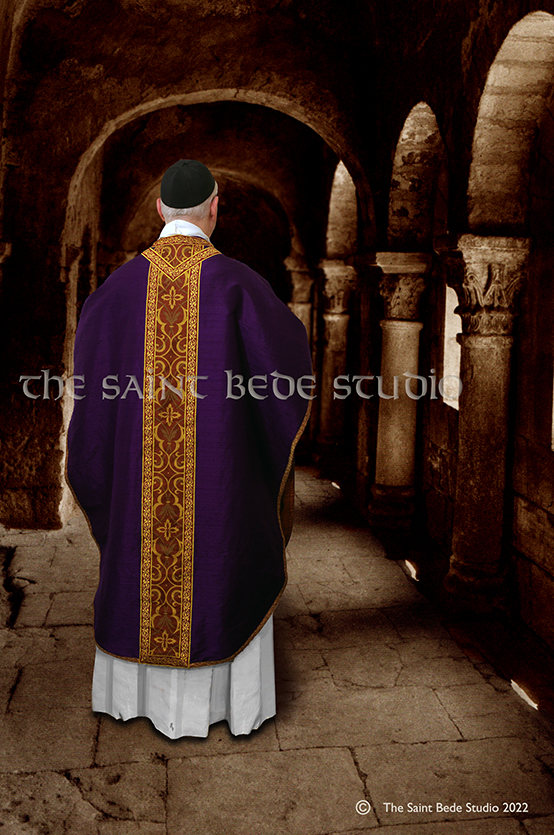
In this Holy Season, we are pleased to present a set of penitential vestments, made for a returning Australian customer.

These vestments were made from dupion silk, in a rich shade of plummy-purple and lined with a taffeta bronze in colour.  The vestments were ornamented in the Roman manner with silk damask in colours of rust-red, subdued green and old gold and outlined with a galloon in colours of burgundy and gold.

Please click on the images for an enlarged view.

Enquiries.

AMDG

The Saint Bede Studio

Saint Philip Neri

The Saint Bede Studio

Saint Philip Neri

Sunday, 27 March 2022

Laetare Sunday 2022

The Saint Bede Studio
Twice a year, the Church breaks the tone of its penitential seasons by the use of rose-coloured vestments. 

Rose-coloured vestments were never commonplace and they still are not.  Many different colours have been deemed by the Church as acceptable as liturgical rose.  Some of these are a salmon shade; some a silvery-pink, almost mushroom-colour; some close to what we would call Bishop's purple or fuchsia; and some red with overtones of gold.

The vestments were made from dupion silk in a quite lovely shade of rose and fully lined in a taup-coloured taffeta.  The vestments were ornamented with a braid from the range of the Studio's unique offerings, called Saint Dunstan.  The braid is in colours of platinum, violet and white upon a crimson background.

Click on the images for an enlarged view.

Enquiries : At this page.


Rose vestments


Rose vestments

Friday, 25 March 2022

On this Feast of the Blessed Virgin

On this beautiful Feastday of the Annunciation, the Saint Bede Studio is pleased to post these images of a set of vestments we completed recently for a returning customer from the United States.

The set of vestments, often seen on the Studio blog, we call Ave Maris Stella.  It is based on designs of the famed genius of the Gothic Revival AWN Pugin.

The vestments were made from a shade of ivory silk damask and lined in Royal Blue taffeta.

Please click on the images for an enlarged view.


Sub tuum praesidium confugimus, 
Sancta Dei Genetrix. 
Nostras deprecationes ne despicias in necessitatibus, 
sed a periculis cunctis libera nos semper, 
Virgo gloriosa et benedicta. Amen.

Thursday, 24 March 2022

A Prayer to the Mother of God

BENEATH YOUR PROTECTION, O holy Mother of God and ever-virgin Mary, we place ourselves, trusting that no earthly trouble is hidden from your tender care. 

MOST HIGHLY-FAVOURED LADY, amid the misery of our sinfulness, weakness and failures, you never cease to remind us that the bountiful God does not abandon us, but continues to look upon us with love, ever-ready to forgive and restore us to new life, if we but turn to Him in repentance. 

ACCORDING TO HIS LOVING PURPOSE, you are ever with us, O Virgin Mary, and in our most troubled moments, you guide us with your motherly concern. God has given you to us and made your Immaculate Heart a refuge for the Church and for the entire human race. With confidence, therefore, we now turn to you, knocking upon the door of your tender heart. 

CLOSE NOT YOUR EARS to our supplications, O blessed Mother, nor delay to come to our aid but untie the knots of our hearts and of our world. At this dark hour, help us and grant us your comfort, for we place our trust in you. 

STAR of the SEA, guide us, lest we be shipwrecked in the tempest of war. 

O PITYING MOTHER, may your intercession soften men’s hardened hearts. Amid the thunder of weapons, may your prayers, O Queen of Peace, turn men’s thoughts away from war. May the tears you shed over our strife make this vale of tears - scorched by hatred and violence - blossom anew. May your maternal embrace comfort those forced to leave their homes and their native land, fleeing from the lords of war. May your sorrowing Heart move us to compassion for our brothers and sisters, God’s children, who are injured and cast aside. 

PILLAR OF JUSTICE, bring to repentance those who have brought misery through the violence of war. 

A WEARY and FEARFUL WORLD stands with you beneath the saving Cross, needing to entrust itself to you, O Heavenly Mother, and, through you, to dedicate itself to Christ. Under your protection we place the Faithful of the Ukraine and Russia, who venerate you with great love, even as your heart beats with compassion for them and for all those peoples ravaged by war, cruelty and poverty. 

INSPIRED WITH DEVOTION and CONFIDENCE, therefore, O holy Mother of God and ever-virgin Mary, we entrust and dedicate ourselves, the Church and all mankind, but especially the Ukraine and Russia, to your Immaculate Heart. To you we dedicate the future of the whole human family, the needs and expectations of every people, the anxieties and hopes of the world. Through your intercession, may God’s mercy be poured out upon the earth and the gentle rhythm of peace return to mark our days. 

O GRACIOUS QUEEN of HEAVEN, restore God’s reign within our hearts and to this troubled world. Amen.

-o-o-o-o-o-o-o-o-o-o-o-o-o-o-o-o-o-o-o-o-o-o-o-o-o-o-o-o-o-o-o-o-o-

PLEASE NOTE :

This is a recension of the Act of Consecration issued by the Holy See for the corporate prayer of the Catholic Bishops of the world on the Feast of the Annunciation.  The text above is purely for personal devotional use, whereas the text of the Act issued by the Holy See is intended to be a public prayer, fulfilling the requests of our Lady during the Fatima Apparitions.

Saturday, 19 March 2022

Vestments for the Penitential Seasons 2022 : 2

Violet vestments
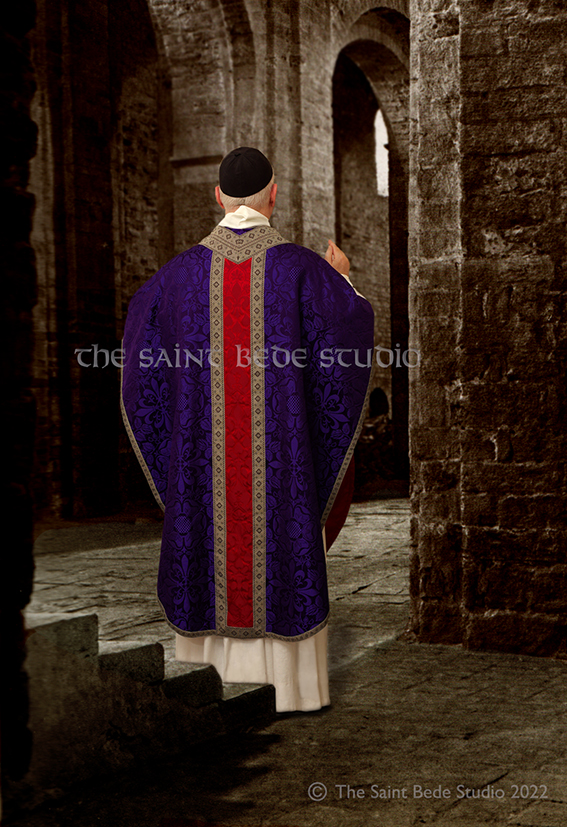
In this Holy Season, we are pleased to present a set of penitential vestments, made for a returning Australian customer.

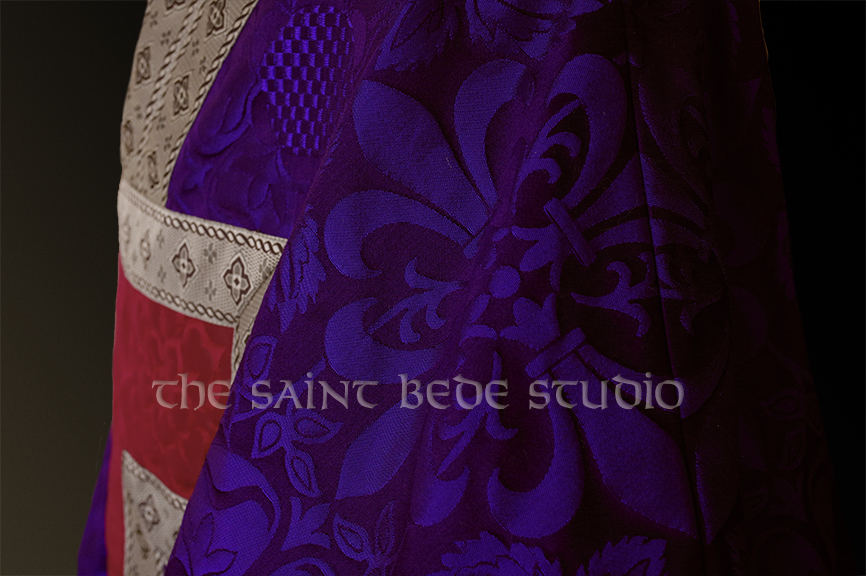
These vestments were made from an English ecclesiastical brocade, in a rich shade of violet and lined with a taffeta red in colour.  The vestments were ornamented in the Roman manner with the crimson red damask, outlined with a galloon in colours of burgundy and grey and a narrow galloon of the same colours.

Please click on the images for an enlarged view.

Enquiries.

The Saint Bede Studio


Saint Philip Neri chasuble


The Saint Bede Studio

 AMDG.

Saturday, 5 March 2022

Vestments for the Penitential Seasons 2022 : 1

Purple vestments
At the beginning of this Holy Season, we are pleased to present a set of penitential vestments, made for a returning customer from the Archdiocese of New York.

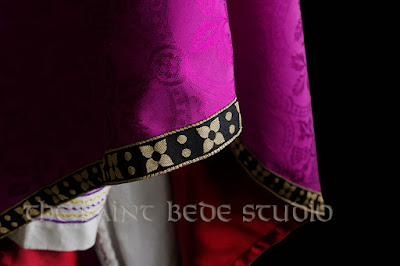
These vestments were made from an English ecclesiastical brocade, in a shade of Roman purple and lined with a taffeta deep-red in colour.  The vestments were ornamented with the Studio's unique braid Lux Aeterna in colours of black and taup and a narrow galloon of the same colours.

Please click on the images for an enlarged view.

Enquiries.


Purple vestments

The Saint Bede Studio


Purple vestments


Tuesday, 1 March 2022

The Agony of the Ukraine


Let us all unite in prayer on this particular Ash Wednesday for the cessation of hostilities in the Ukraine.